Innovation Competition 2026: What Matters to Students Today?

After a long hiatus, the competition returns with roaring success
by Tony Moore
When Brenda Landis started thinking about what an innovation competition at Dickinson could look like in 2026, she didn't want to just dust off the old model. Too much had changed.
"Since the last competition ran, students lived through a pandemic, and the rise of AI has fundamentally shifted how we think about creativity and work," says Landis, student innovation engagement specialist in Dickinson’s department of academic technology. Rather than benchmarking against peer institutions, she wanted to ask a more basic question: What matters to students today?
The answer, it turned out, was a lot of things—and that was exactly the point.
Build It & Change It
This spring, Dickinson relaunched the Innovation Competition as a pilot program through the Burgess Institute for the Global Economy, offering two tracks: "Build It" for new ventures and products and "Change It" for systems and community improvements. The dual structure was a deliberate signal that innovation isn't the exclusive domain of any one major or career path. Twenty-four teams registered. Fourteen submitted full proposals. Eight made it to the finals.
What emerged over the course of the semester surprised even Landis.
"The students exceeded every expectation I had for what could be created and brought to life in just a few short weeks," she says. "I was continually wowed by both the range of ideas and the thoughtful investment students made in building innovations that spanned disciplines across the liberal arts."
The finalist teams reflected that breadth. On the Build It side: Dait, Elevat3d GK, Oasis (+82) and Sarva. On the Change It side: Devil Labs, Green Devils, Phase Forward and WasteLess. The ideas ranged from AI tools and health solutions to sustainability initiatives and campus improvements.
Humans at the Center
One theme kept surfacing throughout the competition. "Every innovation ultimately has a human being who will interact with it, rely on it or be impacted by it," Landis says. "Keeping humans at the center helps keep innovation grounded, understandable and connectable to everyone."
Judges said they saw that grounding in the work. Several teams were already moving into prototyping and real-world application by the time they reached the final round.
When the competition concluded, two teams took top honors. Oasis (+82)—Daniel Kim '26 (international business & management), Aaron Shin '26 (computer science, mathematics), John Lee '27 (computer science), Heewon Lee '26 (biochemistry & molecular biology) and Doheon Kim '28 (biochemistry & molecular biology)—won the Build It track. The team built an offline, on-device AI assistant focused on first aid, drawing on the pre-med backgrounds of several members and months of iteration through hackathons and coursework.
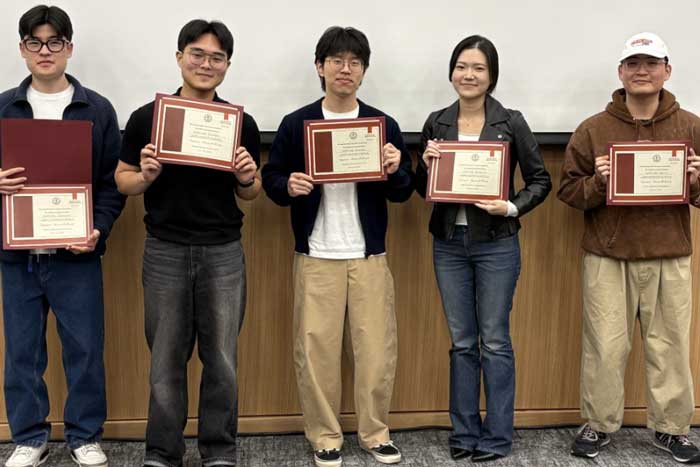
Team Oasis (+82).
"The extended timeline allowed us to think much deeper and refine our ideas thoroughly, especially through invaluable feedback from alumni mentors and professors," says Aaron Shin.
Phase Forward—Brie Farrell (biochemistry & molecular biology, physics), Ethan Lebo (Japanese, physics), Carys Chase-Mayoral (music, physics) and Jillian Mann (environmental science, physics), all class of 2026—won the Change It track with a device designed to heat rooms without electricity, rooted in concepts from their Energy Engineering course.
"I truly believe in our vision of creating something that could make Dickinson, and potentially other colleges and shared spaces, more sustainable through innovation," says Farrell. Winning, she adds, confirmed something the team had quietly believed all along: "It showed us that this idea has real potential beyond the classroom."
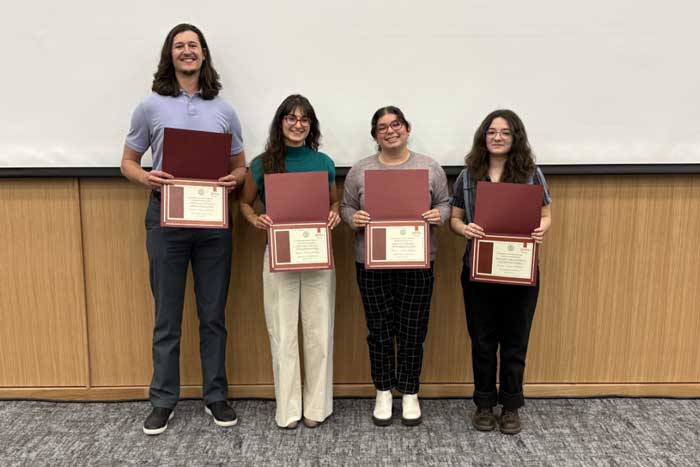
Team Phase Forward.
Community From the Start
The competition drew on expertise from across the Dickinson network. Alumni Jonathan Epstein '96, Scott Winn '95, Greg Morris '88 and Steve Spengler '81 contributed through workshops and remote advising. Slade Reisner '17 served as a judge.
For Epstein, what stood out wasn't just the quality of the work—it was the range of people doing it.
"It was wonderful to see so many different backgrounds bringing their own perspectives to challenges that students see at Dickinson and beyond," he says. "Students were working with materials, with data, with AI, with other professors and with each other."
Winn echoed that enthusiasm: "From our initial kickoff meeting with the teams to their final presentations at Pitch Night, the participating students developed their ideas, talked with potential customers and designed and built prototype solutions," he says. "It was a great experience getting to know them and support their efforts."
Philanthropic support through the Burgess Institute made the relaunch possible. "Donors have been drawn to the Burgess Institute's focus on linking academic learning with real-world problem solving—exactly the kind of experience the Innovation Competition provides," says Rob Beckleheimer '82, associate vice president for advancement. "The Innovation Competition gives students a platform to develop creative, practical solutions to real-world challenges, and it would not exist without this philanthropic support."
Steve Riccio, executive director of the Burgess Institute, framed the competition in the context of what the Institute's namesake intended.
"Mark Burgess '81 believes that innovation is not limited to one discipline or profession but is an essential skill that empowers students to think creatively, solve complex problems and lead with purpose in any career they pursue," Riccio says.
What Comes Next
For Landis, the pilot validated something she'd suspected going in—that when students are given genuine agency over their work, they rise to the moment.
"By building their own crews of creative and technical collaborators, students formed teams that transcended majors and disciplines, allowing brainstorming and problem-solving to expand in unexpected and genuinely delightful ways," she says.
Both winning teams say the experience changed how they think about their own ideas. Shin's advice to future competitors: focus on building something tangible.
"Having a functional, working demonstration of your idea makes a massive difference in how the judges understand your vision," he says. Farrell's is simpler, suggesting that beginning even earlier in the process can be rewarding: "Take your ideas seriously, even if they still feel unfinished. You don't need to enter with a perfect product. You just need to be willing to take the first step."
The plan now is to build on what worked. Future iterations will focus on expanding mentorship, improving access to prototyping resources and finding new ways to support students in taking ideas beyond the competition itself. The goal, as Landis sees it, isn't just to run an annual event—it's to rebuild a sustained culture of innovation at Dickinson.
TAKE THE NEXT STEPS
Published June 3, 2026