Tracing the Journey to Freedom: Students Uncover Hidden History at Historical Black Cemetery

Students use ground-penetrating radar to learn about what lies beneath the ground at the Craig Family Cemetery. Photo courtesy of Yvette Davis.
Project sheds light on enslaved and freed Pennsylvanians
by MaryAlice Bitts-Jackson
First, cross a golf course, a bridge and a creek. Then, travel partway up a mountain. Using ropes, ease down a 45-degree slope. Now there’s only a deer thicket between you and the Craig Family Cemetery.
Nestled on private, wooded land in Dauphin County, Pennsylvania, the cemetery has long been hidden from public view, but it’s emerging as a site of profound historical importance. The only single-family Black cemetery in Pennsylvania that’s listed in the U.S. National Register of Historic Places, it sheds light on the experiences of enslaved and freed Pennsylvanians, the difficult path from slavery to freedom and the ways race, power and families have shaped the local landscape. And Dickinsonians are among those spreading the word.
From enslavement to landownership
The land was once owned by Andrew Craig, born into slavery by the family of Archibald McAllister, an acquaintance of George Washington. Gaining freedom at age 28, Andrew and his wife, Rachel Ente Craig, saved, sacrificed and purchased land next to McAllister’s Fort Hunter estate. Seven of their 11 children survived into adulthood and were educated. They include Hannah, a gifted accordionist and a wet nurse, and Leonard, a railroad worker.
Andrew, Rachel, Leonard, and Leonard’s first wife and child are buried in the Craig Family Cemetery, on land now owned by the Harrisburg Country Club. Additional persons may be buried there too.
There are Dickinson connections. The Craigs likely knew the family of Esther Popel Shaw, a Harrisburg native and Dickinson’s first-known Black woman graduate. And two of Archibald McAllister’s sons attended the college: Richard, class of 1840, enslaved members of the Craig family, and James, who didn’t graduate, was a staunch abolitionist. Dickinsonians are also instrumental to ongoing Craig family research.
The history detectives
The research project was sparked by Yvette Davis, director of Dickinson’s Popel Shaw Center for Race & Ethnicity. In cooperation with the country club and with input from experts in related fields, the Popel Shaw Center is partnering with the Dauphin County Library System and International Institute for Peace Through Tourism (IIPT) to research the site and raise awareness of it.
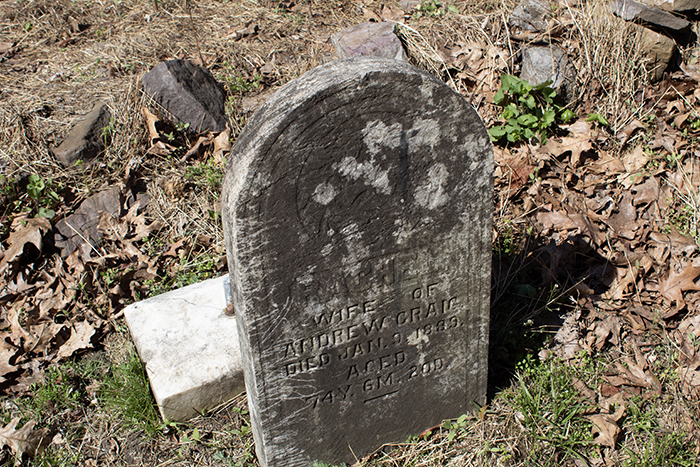
A tombstone for Rachel Enty Craig, a second-generation Haitian American who bore 11 children to husband Andrew Craig. Though she and Andrew were illiterate, all 9 of their surviving children were educated, says Yvette Davis. Photo courtesy of Davis.
Destiny McFalls ’25, an Africana studies major, was the third student to conduct Craig-family research and the project’s first research intern. Working with Professor of Africana Studies Lynn Johnson, McFalls discovered that, in old age, Andrew’s mother, Sal, rented the land she’d once owned.
To share the Craig story, McFalls created a Tik Tok series, History Detectives PA. Across seven episodes, she highlights Rachel’s movement from enslavement to landownership and investigates Hannah’s gravesite, the impact of the railroad on McAllister property and the McAllisters’ lasting influence on the Craig family. McFalls also discusses Dickinson’s ties to the Craigs and invites viewers to help unearth new aspects of the family’s story.
Amiya Marbles ’26 (geosciences, Africana studies) made the difficult-to-access cemetery more accessible to researchers by photographing it. Some of her nearly 70 photos are exhibited in the atrium of the Harrisburg Amtrak station.
Marbles also opened a new research avenue when she discussed the project with Associate Professor of Geosciences Jorden Hayes. Hayes has conducted ground-penetrating radar (GPR) research on other historic cemeteries with unmarked graves. The GPR sends radio waves into the ground and records detailed wave patterns based on how the waves bounce back. Those patterns provide information about what’s underground.
So, one Saturday morning this spring, Hayes took students from her Environmental Geophysics class to the cemetery, with Davis leading the way.
Mapping the unseen
After calibrating the machinery, the students surveyed known burial locations. Then they looked for similar patterns in unmarked sites, navigating carefully across uneven ground and around stone walls and stumps.
One team used real-time kinetic (RTK) GPR to get precise coordinates. Another wheeled a GPR sled across the ground, recording images that showed onscreen in real time. The third group used a ground-based electromagnetic (GEM) sensor to record soil conductivity and magnetization, which can identify magnetic materials like coffin nails and some personal effects.
“It was deeply meaningful to witness the students approaching the gravesite with the reverence it deserves,” Davis says.
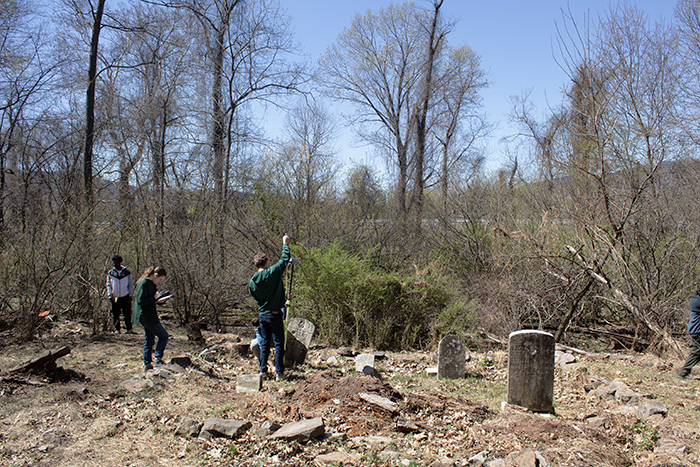
Ten of the 18 students in Jorden Hayes' spring Environmental Geophysics class traveled to the cemetery to collect data, and all of the students analyzed the data. Photo courtesy of Yvette Davis.
Data analysis was challenging, given the age of the remains, and Hayes is verifying the students’ findings. Preliminary results indicate features consistent with burials in both the known gravesites and in additional sites. More burials—undetectable through these methods—are also possible.
“When you’re working with communities where there’s a paucity of historical documentation, information like this can be very important and meaningful,” says Hayes. “We know that there are real people here—people who suffered and were enslaved and also had beautiful lives—who were an important part of this community.”
From research to public memory
The Craig Family Cemetery project has been featured in a WHBG20 TV spot and in The Burg magazine. And its participants are just getting started.
McFall’s soon-to-be-posted Tik Toks and a September speaker series—a collaboration with J.D. candidates from Penn State Dickinson Law—will share research more widely. An awareness-raining campaign will solicit missing pieces of the puzzle from descendants of Harrisburg families. The Dauphin County Library System is planning a Craig Family collection, available online and at library branches. Pennsylvania Past Players will bring Craig family stories to life.
Luca Lorance ’27 (neuroscience), an A.C.E. Peer Mentor, will continue historical research with support through the High Tide Foundation. Davis hopes to partner with additional academic departments and students in coming years.
Marbles recommends getting involved. “Since I’ve come to Dickinson, I’ve looked for ways to connect my coursework with my interest in social justice,” she says. “This has been a rewarding experience, and I’m grateful for the support.”
TAKE THE NEXT STEPS
Published May 29, 2026