Reframing Michelangelo With William Wallace ’74

William Wallace '74 and Beth Fagan Wallace '75 in Italy, where they fell in love during their study-abroad year.
From rain-streaked streets to the Sistine Chapel, tracing a world expert’s extraordinary career
by MaryAlice Bitts-Jackson
An estimated quarter billion people have stood, gape-mouthed, beneath the Sistine Chapel ceiling since it was unveiled in 1512, but a scant few have experienced it like William Wallace '74. Brought in to advise for the historic renovation of the frescoes on the centuries-old ceiling, Wallace stood on scaffolding, some 60 feet in the air, and witnessed a gradual reveal of the work’s original surfaces from a vantage point of only about an inch away.
Those were shining moments for Wallace, the United States’ premier scholar of Michelangelo and one of the top such experts in the world. Decades later, he continues to shape our understanding of the great artist and his work.
Rome in the rain
Wallace came to Dickinson with interest in art and philosophy and no clear idea of what he wanted to do with his life. An inspiringly taught intro-level art history class stoked his excitement and introduced him to the art history profession. But it was Professor Joe Hoffman’s Italian Renaissance class, taken during Wallace’s junior year, that placed the undergrad’s calling in clearer view.
The class included a winter break trip to Italy, and during his first night in Rome, Wallace walked to St. Peter’s Basilica in the rain, intent on better understanding the importance of one of Michelangelo’s most revered works and its place in human history. Wallace emerged with a heightened sense of awe and a vow to return to Italy to learn more. Within months, he had a steerage-class ticket for the S.S. Raffaello and was embarking on a full year of study abroad.
“Bologna is a magical city, and studying abroad there was the most important and informative part of my Dickinson education,” remembers Wallace, who spent his senior year there. “Bologna gave me my career, my joy, my wife and lifelong friends.”
That year, one of those friends, future Dickinson trustee Eric Denker ’75, invited Wallace to join him on a short jaunt to Spain. Envisioning a guys-only adventure of bullfights and late-night tapas, Wallace was taken aback when he learned that Denker had also invited Beth Fagan ’75 to join them. But by the end of the trip, Wallace and Fagan were in love, and later, at their wedding, Denker was their best man.
Challenging assumptions
Wallace earned an M.A. in art history from the University of Illinois in 1976 and a Ph.D. from Columbia University in 1983. That year, he joined the art history faculty at Washington University, St. Louis, where he teaches Italian art and architecture.
The author of nine acclaimed books on Michelangelo, Wallace has lectured at top museums and institutions worldwide, earned numerous faculty awards and grants and held fellowships at Villa I Tatti, Harvard University’s Center for Renaissance Studies in Florence and the American Academy in Rome. He’s also been principal consultant for several BBC television programs on Michelangelo and has appeared as an expert on ABC, the Canadian CBC and the Australian Broadcasting Corporation. In 2015, Dickinson awarded him an honorary doctor of arts. Over the years, he’s challenged and corrected long-held assumptions about Michelangelo and his processes.
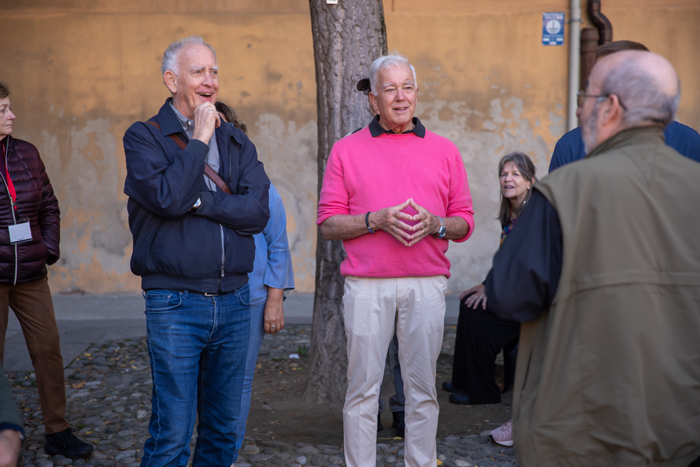
Wallace and Dickinson President John E. Jones III '77, P'11, look on as Eric Denker ’75 gives a walking tour of Renaissance sculpture in Bologna, during Dickinson's celebration of the 60th anniversary of the Bologna program last fall.
Documenting the artist’s vast personal and professional network, Wallace disproved the popularly held notion that Michelangelo was socially isolated. Wallace also highlighted Michelangelo’s extraordinary range as not only a prolific painter, sculptor and poet but also a gifted engineer. For example, Michelangelo found ways to transport eight-ton marble blocks and carve sculptures from atop scaffolds. He also painted 14-foot-tall figures on the curved surfaces of the Sistine Chapel ceiling, making those figures appear proportionately perfect from 60 feet below. And, Wallace noted, Michelangelo didn’t work alone on that project, as many supposed. A team of approximately 13 assistants prepared materials and scaffolds, transferred drawings to the ceiling’s surface, and painted some decorative and architectural elements.
Guiding renewal
In 1980, Wallace was brought in by the Vatican as part of an elite team of global scholars, curators and conservators to consult on the nine-year conservation of the Sistine Chapel ceiling, one of history’s most important works of art, housed in one of the most sacred spaces in the world. Before the advent of electricity, the chapel was lit by candles made with animal fat, and over the centuries, a viscous film of oil, soot and dust had accumulated on the ceiling. The painstaking cleaning and conservation project revealed the brilliant colors Michelangelo painted, some 500 years ago.
The difference was jarring to some who’d become accustomed to the soiled artwork’s more muted appearance. And the conservation of the Sistine Chapel altar fresco, The Last Judgment, created an additional stir. At one point, some of the nude figures had been partially covered up, and the experts decided to restore the work to its original state.
These decisions were controversial at first, but one leading voice expressed support from the start: Pope John Paul II personally thanked Wallace and his fellow experts individually. The group was then treated to a private concert by the Sistine Chapel Choir. “It was an absolutely transformative experience,” says Wallace, noting that electric lights were turned off for the event, allowing natural light to stream into the sacred space.
Architect of hope
Wallace’s appreciation and awe shines through not only in his writing and scholarship but also in his teaching. He’s shared his excitement for art with generations of students and mentees—just as he, too, soaked up inspiration from passionate professors, years ago.
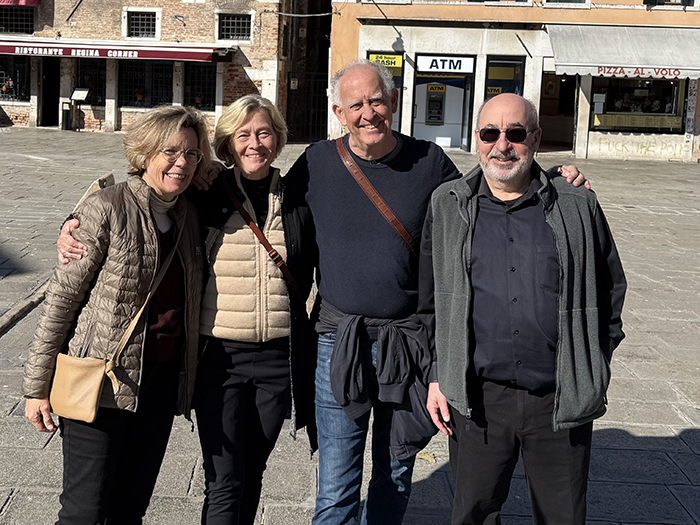
After attending Dickinson's 60th-anniversary celebration of the Bologna study-abroad program this past October, these four longtime friends spent a week together in Venice. Left to right: Beth Fagan '75, Nancy Hooff '75, Bill Wallace '74 and Erik Denker '75.
Today, Wallace teaches part-time, and he continues to research and write. His most recent book, God’s Architect, explores Michelangelo’s later years: During an era when the average life expectancy was about 43 years, Michelangelo lived to about 90, and he worked on St. Peter’s Basilica in his 80s. To Wallace, the Basilica is more than a towering artistic achievement. It’s also the same masterwork that drew this former study-abroad student out into the rain during his first night in Rome, a half-century ago. And it’s a powerfully validating symbol, as Wallace looks forward to a fruitful retirement.
“Michelangelo is the artist I admire the most, because he’s taught me so much about art and about life. In the case of his later work, he shows us that we all can contribute to the world, and keep doing what we love, long after the traditional age of retirement,” Wallace says. “That gives me hope. It suggests that I might still have my own sort of St. Peter’s to build.”
Watch Other Dickinson Alumni Discuss the Impact of their Bologna Experience
TAKE THE NEXT STEPS
Published March 25, 2026