Griffith Fund in Action: From Broadway to Prison Cells, Students Learn Beyond the Classroom

The cross-disciplinary trip to see "Moulin Rouge! The Musical" on Broadway was much more than a night out. Photo courtesy of Adeline Soldin.
Endowed initiative fuels experiential excursions that bring coursework to life in unexpected ways
by Tony Moore
What do a Broadway musical, a maximum-security prison and 40 New York City art galleries have in common? At Dickinson, they're all classrooms.
The Griffith Fund for Humanistic Teaching & Inquiry has been quietly powering a wave of experiential learning across the humanities and fine arts, funding trips and programming that take students out of their seats and into the spaces where their studies come alive. From the neon glow of Times Square to the stone walls of America's first penitentiary, recent Griffith-funded excursions have given students something no textbook can deliver: visceral, firsthand encounters with the subjects they study.
"I really appreciate how the Griffith Fund enhances our ability for students in the humanities and fine arts to do hands-on, experiential learning," says Provost and Dean of the College Renée Ann Cramer P'28. "Through trips enabled by the fund, students and their faculty see shows they couldn't otherwise see, engage with art in professional settings that they wouldn't otherwise have access to and generally see their learning in action."
Scandal at the Cabaret
When Associate Professor of French & Francophone Studies French Adeline Soldin and Assistant Professor of Spanish & Portuguese Amaury Leopoldo Sosa took a cross-disciplinary group of students to see Moulin Rouge! The Musical on Broadway, the trip wasn't just a night out. It was the culmination of two upper-level fall courses—Soldin's seminar on early 20th-century women of Paris and Sosa's course on identity politics, cross-dressing and transgression in early modern theater.
The Moulin Rouge itself is a historical landmark Soldin's students had discussed at length, particularly in relation to the writer Colette's infamous 1907 performance at the cabaret in Le Rêve d'Égypte, in which she kissed the former marquise de Belbeuf—dressed as a man—on stage. The Broadway adaptation brought those themes to life across centuries of performance, giving students in both classes a shared reference point for discussions of metatheatrical devices, adaptation, costume design and the evolution of how marginalized identities have been represented on stage.
Beyond the academic framing, the trip brought together students and faculty from French; Spanish; women's, gender & sexuality studies; theatre & dance; Latin American, Latinx & Caribbean Studies; music; Posse Scholars; and Overseas Student Assistants—a deliberately diverse gathering designed to spark conversations across social and academic circles.
Feeling Foucault
A very different kind of immersion unfolded when Professor of Sociology Dan Schubert took students to Eastern State Penitentiary in Philadelphia and the active State Correctional Institution at Camp Hill, Pennsylvania.
The visits were framed by the class's deep reading of Michel Foucault's Discipline and Punish, which examines how the architecture and surveillance techniques of the modern prison created a new kind of subjectivity—the prisoner. Eastern State, America's first penitentiary, embodies Foucault's concept of the panopticon: 30-foot stone walls, cells lit only from above to inspire repentance and spoke-like cellblocks allowing a single guard to observe every unit.
Camp Hill offered a starkly different but equally powerful experience. As the diagnostic and classification center for the Pennsylvania Department of Corrections, all state prisoners spend six to eight weeks there being assessed—medically, psychologically, educationally, vocationally. Students entered through heavy doors that closed behind them, passed through a security cage and walked a campus under constant camera surveillance.
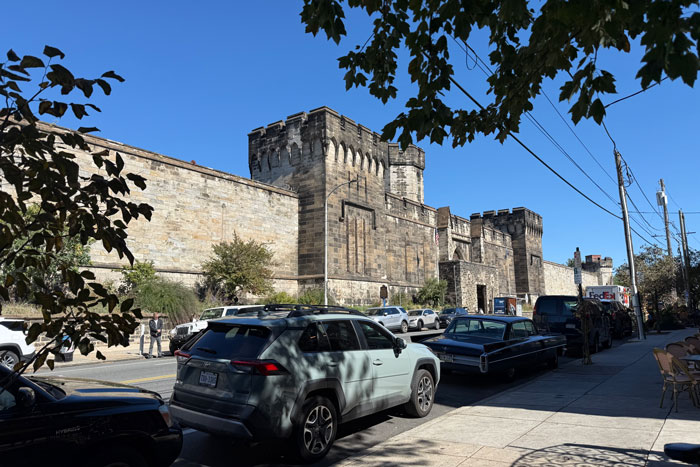
The exterior wall of Eastern State Penitentiary, built in the middle of farmland in the early 1800s.
"You feel this stuff when you walk inside Eastern State and Camp Hill," Schubert says. "Eastern is overwhelming in the heaviness of the architecture. Stone prison cells. Darkness. Cold. You really feel it."
For Siona Bebchick ’28 (sociology), the experience was transformative.
"When visiting each of the prisons, I realized that, while we think we may be aware of the change that occurs around us, most of us are unaware of the change that does not affect us," she says. "Moreover, the trips that we took in Professor Schubert's class were honestly life-changing for me. I realized after taking these trips that I would love to be a social worker in a prison later in my life, working to help those that need assistance in getting out of the system and working towards the goal of rehabilitation."
40 Galleries in a Few Days
Meanwhile, Professor of Art Todd Arsenault took senior art students on a whirlwind tour of New York City galleries and museums—roughly 40 in just a few days.
"There is no substitute for seeing art in person, and the impact of how students connect with the work in a gallery or museum can't be overstated," Arsenault says, adding that being immersed in a space with multiple works allows students to consider the larger conversation that unfolds in a body of work, pushing them to think more expansively. "They can feel the materiality, take note of subtleties that don't come through in reproductions and truly understand the impact of scale."
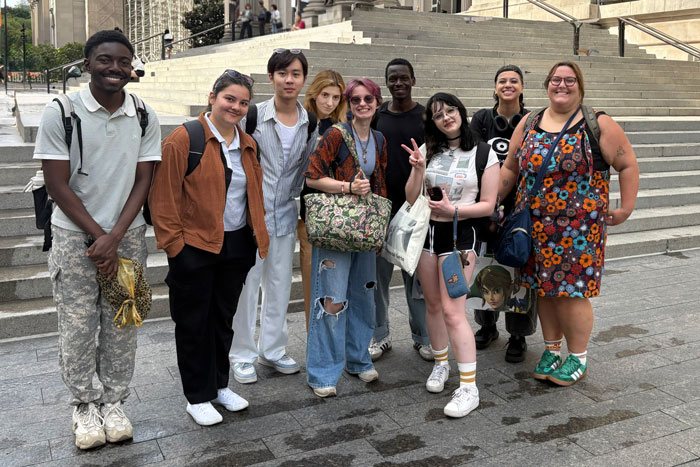
Students visited the Metropolitan Museum of Art on their whirlwind tour of NYC galleries and museums.
That impact showed up immediately in students' studio work. Larry Vandyke '27 (art & art history), one of the seniors on the trip, saw it reshape how he thought about making art.
"This trip emphasized the importance of interrogating and understanding the processes from which a work of art's formal qualities emerge," Vandyke says. "I've realized that understanding what it takes to achieve certain effects in, say, a painting, makes any attempt at investigating a painting so much more rewarding as each mark on a canvas suddenly tells a richer story."
What's Next
The Griffith Fund's reach continues to grow. Recent and upcoming programming includes a student field trip to a monastery in White Haven, Pennsylvania, a visiting lecture by scholar Naomi Miller and a film showing by Cuban filmmaker Rolando Díaz—all made possible by the fund's commitment to bringing the humanities to life, one experience at a time.
"I appreciate how the fund enables faculty to make independent decisions about how to best enhance student learning," Cramer says, "one course at a time."
TAKE THE NEXT STEPS
Published February 25, 2026