Capturing Locomotion: A Close Look at Muybridge’s Groundbreaking Photography
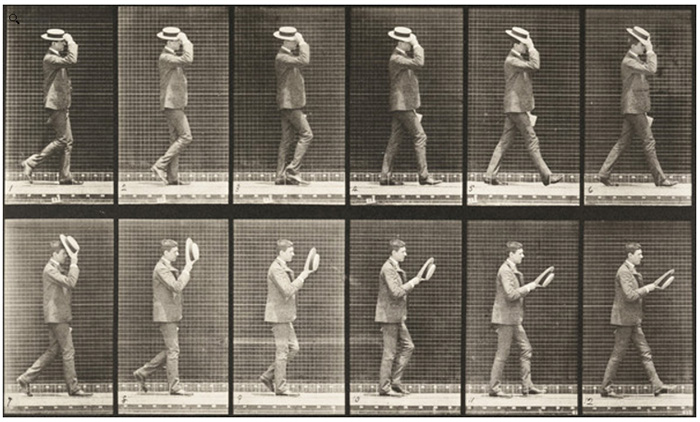
Eadweard Muybridge, Animal Locomotion, Plate 44.
Students bring fresh views to famous works
by MaryAlice Bitts-Jackson
The student-curated exhibition Dissecting Locomotion explores Eadweard Muybridge’s photographic studies of humans and animals in motion and how they transformed our understanding of movement.
In the days before movies and videos, people didn’t have an opportunity to understand the mechanics of high-speed motion. The legs of a galloping horse were a blur to the naked eye, and artists often depicted them like rocking-chair legs—all four outstretched at once. Then came Eadweard Muybridge. His photographic sequences of galloping horses, birds in flight and people in motion brought the mechanics of movement clearly in frame.
A new exhibition lifts the lid off Muybridge’s contributions to art, science and cinema histories. It’s called Dissecting Locomotion, and it’s curated by three art-history majors in Dickinson’s class of 2026.
Milestone works in a milestone exhibition
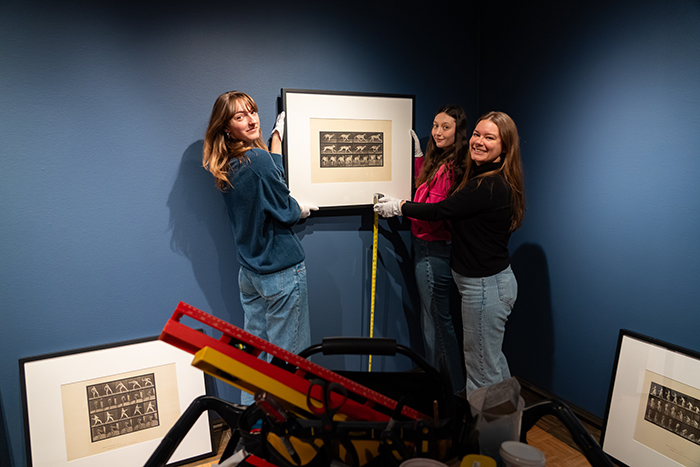
Class of '26 art-history majors Lena Rimmer, Anna Radigan and Abigail Allport researched Muybridge's work and curated the Trout Gallery exhibition. Photo by Dan Loh.
The exhibition focuses on Muybridge’s famous project Animal Locomotion, completed at the University of Pennsylvania in 1887. Muybridge used multiple cameras and a later-patented technique to capture the movements of people and animals in a series of still photographs. The series changed the way we understand movement and paved the way for the development of “moving picture” technologies.
Although Dickinson owns more than 100 Animal Locomotion plates, thanks to a donation from a Philadelphia lawyer, Samuel Moyerman (1893-1966), Dissecting Locomotion is only the second Trout Gallery exhibition devoted exclusively to Muybridge’s work. It is also the first such exhibition to be curated by students.
15 weeks to opening night
The class of 2026’s Abigail Allport, Anna Radigan and Lena Rimmer curated Dissecting Locomotion as the capstone project for their senior art-history seminar. Working together under direction of Professor of Art History Elizabeth Lee, and with help from the Trout Gallery’s director and staff, the students selected the works and designed the exhibition. They also wrote and refined original research, which is published in a full-color exhibition catalogue.
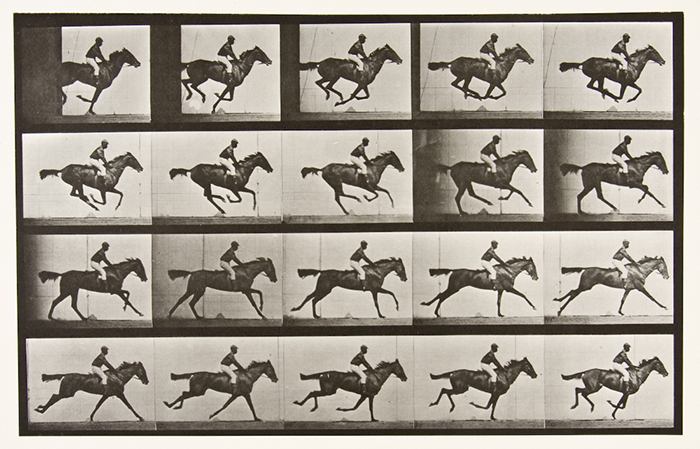
Eadweard Muybridge, Plate 627 from "Animal Locomotion," collotype, 13.75 x 19.375 in., 1887, The Trout Gallery, Gift of Samuel Moyerman.
Much of the work was hands-on. To better understand the technology of Muybridge’s day, for example, the students took a plate-camera and darkroom workshop led by Visiting Lecturer Andy Bale. They also spent time examining physical items in the Trout Gallery’s permanent collection as they narrowed down the pieces they would show and researched individual works.
New views of well-known work
While much has been written about Muybridge’s work over the decades, the students found new angles to highlight in their research. Allport examined the absence of racial diversity in the series. Radigan connected Muybridge’s early-career photographic landscapes to his later work. Rimmer looked to the 19th-century interest in college athletics programs and physical culture to explain the high percentage of photographs of athletes in the series.
"It's surprising to see that even after a whole semester, there is still more to learn about his work and its massive impact," says Radigan, who plans to pursue opportunities in museum curation and education after graduation.
A tip from Associate Dean for Archives & Special Collections’ Jim Gerencser ’93 revealed parallels between Muybridge’s contributions and the photographs of Dickinson’s own Charles Francis Himes, class of 1855, an avid photographer and science professor who augmented his lessons with photographs.
The students will be available to answer questions during the Feb. 20 opening reception for the exhibition. They’ll also lead a Feb. 26 Lunch and Learn session about their experience. It’s a major moment for the student-curators, who put all they’d learned as art-history majors to the test in one major final project.
“We had complete creative control over everything from the exhibition’s overarching themes to the gallery wall color,” says Allport. “I’m grateful to the art department and gallery faculty for their help, and I’m so proud of how the show came together.”
Learn more about spring 2026 exhibitions at Dickinson.
View more upcoming public arts events.
TAKE THE NEXT STEPS
Published February 12, 2026