Always a Dickinsonian

Brian '93 and Laura Kamoie '92 enjoyed the legacy family tradition of handing Cara '26 her diploma at Commencement. Photo by Dan Loh.
How Dickinson becomes a family tradition—and why legacy students and their parents wouldn’t have it any other way
by Tony Moore
Heather Kurey ’98 was in the hospital, giving birth to her daughter Marley, when a Dickinson alum came to spend the night with her. Not a family member. A friend from college—the kind of friend Dickinson tends to create.
Marley ’27 is now a junior at Dickinson, a member of the track and field team and a Dickinsonian in her own right. Her dad, Bryan ’98, is also an alum. For the Kureys, Dickinson was never really a college to be chosen so much as a community already lived in.
“None of us directly ‘pushed’ Dickinson on Marley,” Heather says. “But the community was ever-present in her life.”
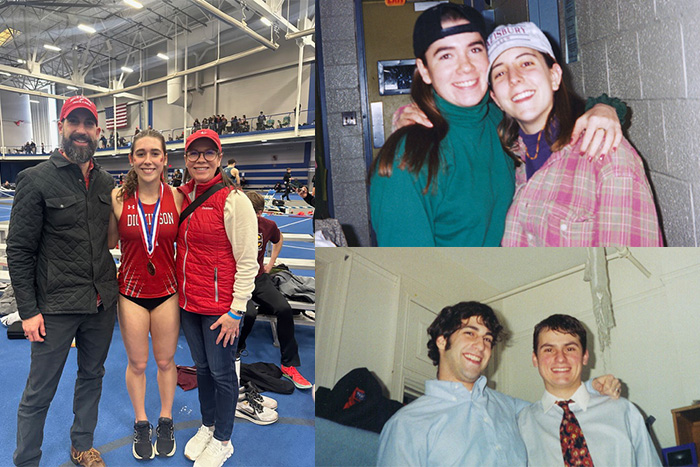
The Kurey family.
The Kureys are one of a growing number of multigenerational Dickinson families—and nearly one in 10 students in each incoming class now arrives with some kind of legacy connection. They come from families where Dickinson isn’t a chapter but a thread: something woven through decades of dinners, stories and relationships that outlasted graduation by decades.
What draws these families back, generation after generation, is harder to quantify. It tends to show up in moments. In a phone call. In a red Adirondack chair.
Their Campus, Too
Beatrice Taormino ’29 was FaceTiming with her mother, Dale ’92, one afternoon recently, sitting outside in the first real Carlisle sunshine of the season. She was in a red Adirondack chair—the same iconic chair that sits, rain weathered, in the Taormino backyard at home in California.
“Flipping the camera, I gave her a panoramic view of the academic quad,” Beatrice recalls. “ ‘I love that campus,’ she said. And in that moment I could see her, 30-something years before, enjoying the same sun and the same view.”
The list of Dickinsonians in the family doesn’t stop there: Beatrice’s father, Jason ’93, in government relations with Pacific Gas & Electric, is also an alum. Jason’s sister Megan McFarland ’02, Megan’s husband Jeff McFarland ’03 and Jeff’s brother Matt ’02 all attended. When Beatrice chose Dickinson—for its neuroscience program, for study abroad, for softball—she was, in some sense, choosing to see what all those stories looked like from the inside.
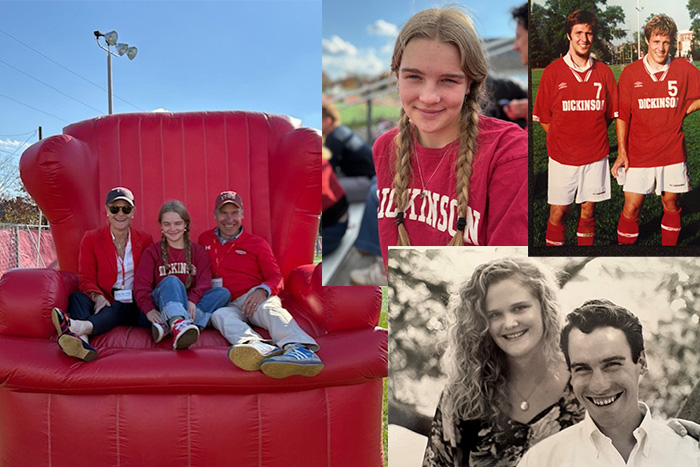
The Taormino Family
As Jeff McFarland puts it, “The unique quality of the experience at Dickinson is like a secret that we all share, and only those who’ve experienced it can really understand it.”
The Kamoie family has its own versions of that shared secret. Brian ’93 and Laura ’92 led the way for their daughter, Cara ’26. Brian proposed to Laura, now a bestselling author, in the cupola atop Old West on a December night, snow falling on the campus below. Both worked in the dining hall as first-year students. Cara did too.
“We’ve all sat on the old stone steps of Old West and contemplated the world, taken a picture or just caught our breath,” says Brian, a managing director at Deloitte. During his year abroad in Bologna, Italy, his work-study job was cleaning the Dickinson Center after hours. Cara has since stood in that same center.
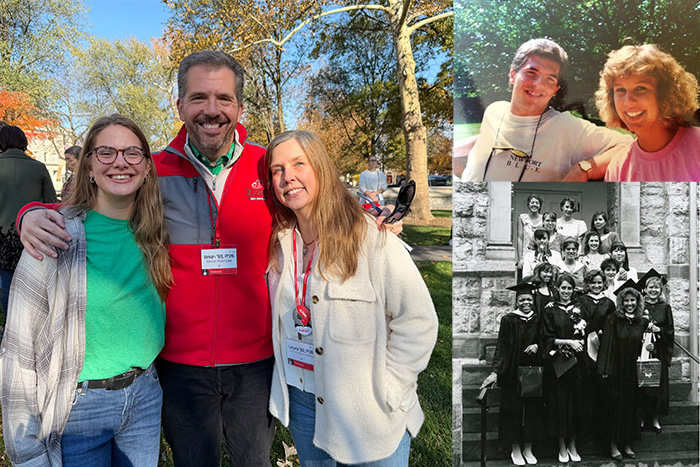
The Kamoie Family
There’s something almost uncanny about the way Dickinson’s character persists across the years—same limestone buildings, same tight-knit rhythms, same library with its study nooks waiting to be claimed.
“We loved hearing how Marley found her own secret hiding spot in the library for studying, just like we both did—all different spots,” says Bryan Kurey, now head of insights and data at IANS Research, a cybersecurity firm. Different spots, same instinct.
Making It Their Own
“My family never pushed me to choose Dickinson and emphasized that I make a decision based on what feels best for me,” Marley says. “Through hearing about their unique Dickinson experiences, I was excited at the opportunity to make Dickinson my own.”
For Cara Kamoie, that shift—from Dickinson as her parents’ college to Dickinson as hers—came at Admitted Students’ Weekend. She’d visited campus her whole childhood, but something was different about walking onto it as a prospective student.
“I think I had always had a mental view of Dickinson as ‘my parents’ college,’ ” she says. “But attending my first Dickinson event aimed at me changed that. In that moment, Dickinson felt like my college in a way it hadn’t before.”
Marley’s tipping point was an overnight visit with the track team—eating with the athletes, staying in the dorms before she was even enrolled.
“Being with them felt like I was hanging out with a group of my friends,” she says. “These experiences showed me how much everyone in all areas of campus truly cares about their Dickinson experience and making people feel like they belong here.”
Dale Taormino is happy Beatrice made the right choice for herself and found her place, and now they have something else special to enhance the mother-daughter bond. “Having our daughter now become a Dickinsonian and loving it is another connection between us that we love,” says Dale, VP of sales North America, at Vistex. “It’s a wonderful thing to share with your child!”
The Dickinson Effect
When alumni from these families try to describe what Dickinson gave them, they often reach for the same language—curiosity, confidence, a way of thinking through problems. And then they notice they’re watching their own children develop it.
“Dickinson had a profound impact on the way we think about problems in work and even in life,” says Heather Kurey, director of operations with O’Melveny. “Bryan and I have always talked about the importance of asking good questions, doing the research, coming up with your own answers and expressing your point of view both in discussion and through careful, impactful writing. We see how much this has become the way that Marley approaches problems, and we now have a common way of looking at things as a family.”
Brian Kamoie puts it in terms of the world opening up. Dickinson gave him the confidence to learn across disciplines, and study abroad gave him a lifelong interest in other cultures. He sees both now in Cara, who spent time in New Zealand and on the Mosaic program in Norway.
“Her time abroad gave her new perspectives and the quiet confidence to engage the world and approach challenges creatively,” he says. Cara frames it in terms of drive—a quality she traces directly to watching her mom and dad. “Both of my parents took full advantage of the opportunities available to them at Dickinson, and I’m proud to say that I think I have done similar things,” she says. “I recognize a drive for leadership and service in both my parents that Dickinson has allowed me to develop.”
Marley describes finding something she’ll carry forward regardless of where she goes next.
“My Dickinson experience has shaped me in countless ways, most importantly in how I’ve been able to find my own voice and confidence—and also find and build community in every sphere I belong to here.”
And then there’s Beatrice, who just finished her first year, having arrived with high expectations and a family full of stories.
“As you go through high school, the classes you take are more to meet graduation requirements and less for genuine interest,” she says. “Coming to Dickinson has allowed me to fall in love with learning again and allowed my inherent curiosity to flourish.”
The Place They’ll Remember
Ask any Dickinson legacy family for a shared campus memory and the answers tumble out: Deli C at midnight, South Mountain in good weather, Biddle Field, Old West steps at dusk.
Matt McFarland, a partner with BroadOak Capital, still friends with many of his Dickinson classmates, was sold on the college at a ’70s-themed costume party with a live band—held during a recruiting trip in perfect spring weather, with a camaraderie that reminded him of his high school. That and playing lacrosse and soccer led to a “perfect fit.” His brother Jeff remembers early-morning practices in the Kline Center, moving his car out of the Witwer lot on Sunday mornings for church and trips to Possum Lake. The Kamoie family shares memories of Mathers Theatre—performing onstage, cheering from the seats.
What makes these details matter isn’t just nostalgia. It’s that the current students recognize them, like when Marley mentions a campus experience and her parents light up. Or when Beatrice flips her phone camera to show her mother the quad. That overlap—not identical, but unmistakably related—is what legacy families describe as the thing Dickinson gives that can’t quite be listed on a website.
The college punctuates these moments regularly: As new students’ journeys get underway during Orientation, a welcome reception is held for incoming legacy families, where students can make connections with other multigenerational Dickinson students and families. And at the end of the on-campus journey, Dickinson has a celebration for graduating legacy students, including the chance to receive a diploma from a family member who is also an alum, a tradition that finds 30-50 students each year joined on the platform by family.
A thread is formed across the years, across generations, one held together by people, places and moments. (That thread is the longest for the Asbell family, with 13 members having attended Dickinson across generations.) And it shows no signs of fraying.
“We’ve been so glad to see that Dickinson has been able to maintain what makes it distinct while continuing to keep up with how higher education and society more broadly are evolving,” Bryan Kurey says. “Students at Dickinson today, legacy or not, have a very different experience than we had, all for the better. But there is a familiarity there that creates a connection across many decades.”
Know a future Dickinsonian?
Help us reach the next generation! If you know a high-school student who would thrive at Dickinson, submit a referral so our admissions team can connect with them.
Read more from the spring 2026 issue of Dickinson Magazine.
TAKE THE NEXT STEPS
Published June 9, 2026