New Frontiers: Dickinson Students Tackle Global Megatrends at CSIS
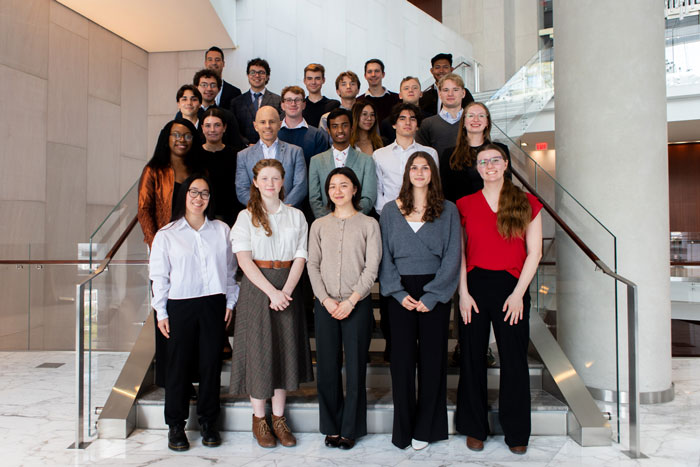
“The excursion was a fantastic opportunity to deepen my understanding of economics and demography,” says Maggie Maston ’28.
Workshop at leading think tank surfaces challenges on the world’s most pressing issues
by Tony Moore
The questions shaping the next decade—such as who will have water, who will feed their populations, how energy systems will transform and where geopolitical fault lines will fracture—don’t resolve neatly in a classroom.
So recently, a group of 22 Dickinson students headed to the Center for Strategic & International Studies in Washington, D.C., where they spent the day at the Hess Center for New Frontiers working alongside policy professionals on the problems defining our era.
Mapping the Future
The visit drew students from across Dickinson’s academic curriculum and was organized by Steve Riccio, senior lecturer in international business & management and executive director of the Burgess Institute for the Global Economy, which sponsored the event.
The day began with immersive presentations on global megatrends—shifting demographics, water and food security, energy transition, and rising geopolitical tensions—followed by a capstone scenario planning exercise that asked students to apply foresight tools to real-world situations, working in teams to develop and present future-oriented strategies.
“The experience gave students both a conceptual foundation and a tangible sense of how this kind of thinking plays out in professional contexts,” says Riccio. “That combination is exactly what we’re trying to create through the Burgess Institute.”
What emerged from the morning sessions wasn’t a set of tidy answers but something more useful: a map of how these forces connect, collide and compound one another.
Claire Hawks ’28 (economics) noted that the event shed light on how rapidly the world is changing and how interconnected global issues are, creating “a web of causes and effects.”
And Noelle Artinian ’28 (quantitative economics) noted that “being able to participate in this workshop gave me insight into how global issues ripple through various spheres. Through a case study exercise simulating a cybersecurity threat, I was challenged to think beyond the theories learned in my macroeconomics course and collaborate with peers to brainstorm consequences of such an event—politically, economically and socially.”
Mapping Personal Futures
For Maggie Maston ’28 (international studies, quantitative economics), the day sharpened thinking she had been building in the classroom—and brought it into focus at a scale she hadn’t encountered before.
“The excursion was a fantastic opportunity to deepen my understanding of economics and demography,” she says. “It allowed me to apply concepts from my coursework on a broader scale, particularly in examining how long-term population dynamics—such as aging, fertility and labor-force composition—interact with productivity and shape economic growth trajectories. This experience reaffirmed my interest in pursuing a career at the intersection of public policy and economic research.”
The day concluded with a career panel featuring CSIS professionals, who shared their own paths into international affairs, policy analysis and global strategy. For students still charting their courses, it was a rare opportunity to see what those careers actually look like in practice—and to ask the people living them.
“This trip gave me clarity for my future and what I desire from it,” Hawks says, on how the event went beyond professional development. “It solidified my goals in my mind and gave me even more motivation to chase what I want.”
TAKE THE NEXT STEPS
Published April 28, 2026