Forty Years of Language and Cross-Cultural Communication
In the spring of 1984, professors Arturo Fox and Andrés Surís visited Málaga to establish a Spanish-language study abroad program. Professor Surís, who had lived in Málaga until the Spanish Civil War, had immigrated to Cuba and then the United States. Prof. Fox was also a Cuban exile, and the two former lawyers met as graduate students at the University of Minnesota. Surís suggested Málaga because of its location, its being a provincial capital, having approximately a half million inhabitants, a great climate, a welcoming atmosphere for student homestays, and a young 25-year-old university with talented young professors interested in attracting an American program to its Cursos para Extranjeros at the University of Málaga. Dickinson could be the University of Malaga’s only U.S. program.
After this initial visit, Professor Arturo Fox took a small group of Dickinson students the summer of 1984 for a pilot summer immersion program, and he worked with University of Málaga professors who were the administrators, Director and Vice Director respectively, José de la Calle and Salvador Montesa at the Cursos para Extranjeros. In the fall of that same year, Prof. José de la Calle visited Dickinson for a week to meet faculty in the Department.
Following that visit, Spanish Department Chair Grace Jarvis was scheduled to go to Málaga in January of 1985 to meet with the Rector of the University of Málaga, José Marîa Martín Delgado and set up budgets and academic program for the first fall/full year program. During that very cold January of 1985, Chair Jarvis and Professor Salvador Montesa, vice director of the Cursos para Extranjeros prepared the first budgets, descriptions of courses (already approved by the Dickinson Academic Program Committee), brought Dickinson faculty syllabi for courses that would be the design for courses that would receive credit and grades at Dickinson, and gathered CVs. The first outlines, which are in the archives at Dickinson, included various options. For example, if there were twenty students there would be four courses taught just for Dickinson and one course at the Teatinos campus at Facultad de Filosofía y Letras of the Universidad de Málaga with Spanish students for credit/no credit. If there were only 15 students, there would be 3 courses taught just for DC students and two courses at UMA. If there were 10 students, there would be 2 courses for DC at Cursos and 3 at UMA. The ones at UMA would be credit/no credit.
The 1980's
Professor of History Neil Weissman was the NEH director for three years from 1984-1987.
Grace Jarvis was to be the summer immersion director in 1985 (photo), and that preceding January she met with the professors who would be the summer immersion program professors. Prof. Fernando Arcas (History), Prof. Antonio Garrido (culture), Prof. Eugenio Carmona (Art History) and Prof. Fernando García (language). Prof. Carmona traveled with the program on academic excursions to Granada, Sevilla, Cordoba. She also met with Manolo Jiménez Bravo who accompanied the group to Madrid and its environs and to Tetuan Marruecos. For the following decades Manolo Jiménez would be a constant companion to the various directors and students during the spring semester and summer academic excursions over the years. (During the fall semester, the art history professor generally accompanied the group, and some years both the art history professor and Manolo Jimenez would accompany the resident director). Students learned to sing “Sevillanas” accompanied by Manolo on his guitar on the bus and learned so much about Spanish culture and history along the way.
Concurrently, in 1982 –1985 a committee at Dickinson was formed to apply for a National Endowment for the Humanities grant to prepare the application with the guidance of Associate Dean Peggy Garrett. The NEH grant was to establish foreign language-based programs in Germany, France, and Spain. Chair Grace Jarvis represented the Spanish Department on that committee for the full three years. The application was successful, and Dickinson was granted the multimillion-dollar grant which helped fund what would be the foreign-language based international programs in Bremen, Germany, Málaga, Spain and Toulouse, France. Pres. Sam Banks, Director of off-campus studies Jack Henderson, and James Nicholson treasurer. Peggy Garret was the Associate Dean. Each country’s program was unique, but each had in common a semester/full-year option geared toward majors, a summer immersion option for students who had completed an Intermediate Language course or a three-course language sequence, and a faculty summer immersion program for professors to refresh their language skills and promote foreign languages across the curriculum. Unique to Malaga and very important in second-language acquisition was the homestay experience, which included three meals a day, laundry, and a single room for the Dickinson student who would be the only American student in the household. Faculty participants in the faculty summer immersion programs were committed to including a foreign-language option in their courses taught in English back at the Carlisle campus, thus beginning Foreign Language Integrated Course option (FLIC).
The Málaga academic year program and the summer immersion have continued without pause, except for Covid, for forty years.
In January of 1985, Chair Grace Jarvis also interviewed candidates for the first Overseas Students Assistants (OSA) from Málaga. The first OSA was Concha Barba who later received her PhD at Penn State University and taught Spanish language and literature at the University of Charleston. The first fall/full year program (academic year 1985-1986) with Professor Arturo Fox as resident director had 20 students. That same year, Professor Salvador Montesa was invited to teach Spanish language and literature at Dickinson College. The philosophy of the NEH was to have a foreign presence on the Carlisle campus as well. For the first three years of the full-year academic program we invited three tenured University of Málaga professors from the Department of Spanish language and literature to Dickinson. 1985-1986 Professor Montesa and family came to Carlisle, where he taught Spanish language and literature and Professor Fox and his wife Rosa went to Málaga. In 1986-87 Professor José de la Calle (Fulbright Scholar) and his family came to Carlisle and Professor Carlos Cortinez and his family went to Málaga. In 1987-88 Professor Antonio Garrido and his wife Laura Olarte went to Dickinson and Professor Christopher Anderson went to Málaga to direct the fall/full year program.
After two academic year programs, three summer immersion programs and a faculty immersion program, the College decided it was time to formalize the relationship with the University of Málaga. Grace Jarvis had hosted the NEH Director Neil Weissman for a Málaga summer immersion visit in 1985 and President Sam Banks and his wife Joanne Troutman visited Málaga during that same summer. They were all able to meet faculty and administrators. All returned to campus with accolades.
In May of 1987 the Rector of the University of Málaga, José María Martín Delgado was invited for graduation weekend when he would receive the Doctorate Honoris Causa. That week at the traditional Faculty Trustee dinner, there was the signing of the first Accord with Acting President George Allan and Rector José witnessed by Spanish Department Chair Grace Jarvis. At the dinner there was Spanish Department student entertainment. There was also a Lorca play directed by visiting scholar José de la Calle, with Spanish Department students at Mathers Theater, honoring the weekend of the signing of the Accord. (Accord included in Appendix)
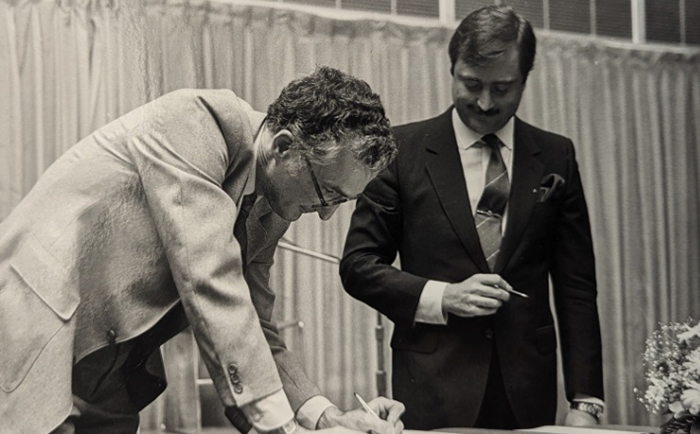
Acting President George Allan and University of Málaga Rector José María Martín Delgado
After these first three one-year terms for Spanish Department resident directors going to Málaga and visiting scholars from UMA coming to Dickinson in Carlisle, the Spanish Department decided it would be best, when possible, to send faculty for two-year terms, rather than one. There was also the issue of constantly looking for new housing for the resident director, so in 1989 Dickinson purchased an apartment for the use of the full-year resident director and family. Professor Arturo Fox and Treasurer Michael Britton made the purchase in consultation with Dickinson trustee Otto Rothemund who had a second home in San Pedro de Alcántara in the province of Málaga, and lawyer Gabriela Domingo and accountants Antonio and Luis Rubio.
When we received the multimillion-dollar National Endowment for the Humanities grant, it put Dickinson on the map for excellence in international education. Grace Jarvis delivered a paper at the AATSP (American Association of Teachers of Spanish and Portuguese Conference on International Programs Abroad in the University of Navarra, Spain). The paper was entitled “Innovation vs. Tradition—Foreign Language Programs in the 1980s”. She was also invited to deliver a paper at the Modern Language Association meeting in December 1988 in New Orleans entitled “Three Years Later—Curricular Implications for the Dickinson College Fall/Full Year Program in Málaga, Spain.” We were getting the word out about our own study abroad programs.
In 1988, because of our strong foreign language and study abroad programs, Dickinson was chosen to host the foreign language institutes of the Commonwealth Partnership,12 highly selective liberal arts colleges in Pennsylvania. The Commonwealth Partnership funds, created by generous contributions from the Pew, Mellon, Dodge, and Wells, were administered by Administrative Director Marjorie Merklin of Franklin and Marshall College. The Commonwealth Partnership chose faculty members, Silvie Davidson, French, Dieter Rollfinke, German, Grace Jarvis, Spanish. Each professor directed five institutes over a 20-month period for 75 high school teachers, 25 in each language. One of the institutes (five weeks) took place at our foreign study sites, where they lived in home stays, took classes with our faculty there who had taught our students during the academic year, and went on academic excursions with our guides. These high school teachers from all over the commonwealth were enjoying the fruits of our labor and passed on their positive experiences to their administrators and students. We also received funds from Dodge Foundation and with that money invited 25 Spanish, French, German High School teachers to the United States for a week to shadow the fellowship grantees at their high schools across the Commonwealth. There was one caveat, we had to include candidates from New Jersey.
Associate Dean Stephen C. MacDonald , in collaboration with Sylvie Davidsonl Grace Jarvis and Dieter Rollfinke wrote a wonderful description of these institutes “Rekindling the Love of Foreign Languages” in the NEA Highter Education Journal Volume VII Number 1, Spring 1991.
The exchange between the Málaga high school teachers and the US high school teachers created lasting friendships and lifelong collaborations that continue to this day. Professors Salvador Montesa and Antonio Garrido were our primary Málaga contacts and because each of them had taught at Dickinson for a year, they were deeply familiar with both academic cultures. It was a truly cross-cultural experience.
In the 1980s we established a strong foundation and collaboration with the University of Málaga and the more people we invited to Carlisle, the broader our contacts became in Málaga, now extending to the wider cultural community.
The 1990's
The spring of 1990 Jarvis organized a symposium “España después de Franco” for a newly created High School-College teacher alliance and almost all Commonwealth Partnership teacher fellows came to campus for the weekend, as well as Professors Montesa and Garrido, poet Juvenal Soto and Ambassador Alberto Aza, who had been the head of the cabinet of Adolfo Suarez during the transition from the dictatorship to democracy. Dickinson alumna Julia Gascoyne and New York High School teacher gave one of the workshop presentations during the weekend. Many of the high school teachers started attending professional conferences, and giving papers on assuming leadership positions.
In academic year 1990-91, Director Grace Jarvis established the first internships and a course on Cross Cultural Communication for International Managers, cross listed with IB&M 300. Those internships took students out of their academic bubble into the Málaga community at the Picasso Foundation, Tourism at the City Government, Cultural Foundation of the Generation of ’27, Guardería Giardinetto Day Care Center, and many more. Every full year student had an internship. (see Appendix) Many of the directors who followed in the next two decades continued to offer the internship option for the spring semester, often adding new options according to interest and availability.
In 1993 novelist Antonio Soler and poet and dramatist José Luis Miranda came to the Carlisle campus for a literary symposium. In the coming decades Professors Noel Luna, Mark Aldrich, and Jorge Sagastume and others organized Poetry Weeks, Semana Poética, to which many poets from Málaga were invited.
In the spring of 1996 composer Antonio Meliveo and writer Antonio Soler had a two- week residency at Dickinson, collaborating with students of Professor Mark Aldrich. They worked with the artists in residency on composing a soundtrack to the novel Héroes de la Frontera of Soler. It was a unique and especially interesting experience for the students.
That same spring of academic year 1995-96 the Málaga Fall-Full Year program celebrated its tenth anniversary. The composer/theater director, Antonio Meliveo helped facilitate our using the Teatro Cervantes, the largest municipal theater in Málaga for a theater production of the original work, CASTING, a la caza de Bernarda Alba, of the theater group La Hora de Té Atroz. The play was a spoof on a Lorca tragedy and there was a lot of audience participation. We had use of the entire theater, all 800 seats, and could invite all students, faculty, host families and friends of Dickinson. Resident Director Grace Jarvis also invited Dickinson Trustee Otto Rothemund to represent the College, as well as Professor Todd Wronski of Theater Arts and director in Norwich that year. There was a party at the Restaurant 7 de julio afterwards for administrators, faculty, students. (See article in Dickinson Magazine, winter issue 1997 in appendix for photos by Piece Bounds, Dickinson photographer who came to Malaga to follow students for one week).
In the fall of 1999, the musical group of Manolo Jiménez Bravo came to campus for a series of concerts with six flamenco artists: two guitars, drum, mandolin and two flamenco dances. President Bill Durden enthusiastically supported their visit. As well as standing room only concerts at Dickinson, with student participation for the finale, the group played at the Pennsylvania Modern Language Conference in Philadelphia.
In 2000 Antonio Soler was invited to be a writer-in-residence during the spring semester. As a novelist, journalist and screenwriter, his productions while at Dickinson gave Dickinson College recognition.
Also in 2000, Grace Jarvis nominated Antonio Banderas for an honorary doctorate at graduation. When she had met him at his home in Los Angeles in 1997 she had been very impressed with his crossing linguistic and cultural barriers, his 65 films in Spain, his work with the United Nations. Jarvis believed this is what we tell students they could do after studying abroad and living in another culture. She presented the idea to President Bill Durden, who was enthusiastic and the faculty approved. José Antonio Dominguez Bandera accepted our invitation, and was accompanied by his wife/actor Melanie Griffith and his parents José and Ana, and fellow Green Moon producer Antonio Meliveo. Grace Jarvis wrote the citation for the doctorate which is in the appendix. Antonio Soler, writer-in-residence in interviewed Banderas for the Spanish weekly magazine El Semanal. The three Antonios gathered at the Jarvis home with faculty and alums of the Málaga program.
The 2000’s
The Málaga Fall-Full year program celebrated its 15th anniversary at the Centro Cultural del 27 with students reading poetry of that generation, and contemporary writers reading their own original works. Antonio Meliveo was master of ceremony and the poets Rafael Ballesteros, Juvenal Soto, Antonio Mesa Toré and writer Antonio Soler all read their own works. Professor of translation studies and poet, Francisco Ruiz Noguera introduced the group. The celebration was organized by Director Grace Jarvis with the assistance of Alberto López Gonzalez. As with the tenth anniversary celebration in Teatro Cervantes, faculty, students, host families, internship supervisors and cohorts, and former Overseas Student Assistants (OSAs) attended. Inclusivity was important. The reception was on site with music composed by Antonio Meliveo.
In 2001-2002 academic year there were 28 students, an especially large group and they arrived to Málaga on September 10th, one student from Colorado who had missed his flight, arrived on 9/11/01, his mother obviously frantic until we could call and let her know he was fine. No one left, in fact several students changed to full year status, and consequently more internships were needed. In one internship at the Centro Cultural del 27 where Sarah Eschelman was placed, her project was to interview the authors who spoke at the 15th anniversary celebration and translate their works, with the assistance of Alberto López and Grace Jarvis. Sarah boasts four generations of Dickinson graduates. She translated the poems and texts for her final project as part of her internship seminar.The book CELEBRATING CULTURE AND COLLABORATION, edited by Grace L Jarvis, with translations by Eschelman, López and Jarvis in 2003. This is one example of how our Dickinson students were able to interact with the cultural community cultivated through the years in the city of Málaga.
In academic year 2008-9 there was an active presence of Málaga on the Carlisle campus. There was a last-minute resignation in the Spanish Department and Alberto López taught the fall semester and Salvador Montesa taught the spring semester. The Málaga presence on campus always facilitated recruitment for the program.
Also in December of 2008, Antonio Banderas returned to campus, this time in the role of director of the movie, El camino de los ingleses, the prize-winning novel of Antonio Soler. Jarvis and López has translated the screenplay, and Jarvis asked them to come to campus to talk about what it means to take a novel to a screenplay to a film. They fulfilled their promise to her and the film was shown in Carlisle Theater to an audience of 800 people. Dean and Provost Neil Weisman introduced the event, Grace Jarvis was moderator and Alberto López was interpreter. There was a bilingual Q and A session. We were honored to host the U.S premiere of the film (Summer Rain, English title). Soler and Banderas spent the weekend at Jarvis home.
In 2009 Department Chair Jarvis approached Provost Neil Weissman about plans for the 25th anniversary celebration in 2010. Weissman, who had also been very supportive of our international programs since his time as NEH Director, was very open to Jarvis’ ideas. They were: Have a reception at the Instituto Cervantes in New York City for alums, former full year resident directors, key faculty members who had taught for us during the 25 years, Fernando Arcas, Salvador Montesa. The Rector and Dean of the University of Málaga, Adelaida de la Calle (she was unable to attend), Juan Antonio Perles, Director of the Cursos para Extranjeros, Ines Carrasco and Sara Robles. Antonio Soler representing the cultural community was invited as well. President Bill Durden and Provost Weissman, as well as Professors Enrique Martínez -Vidal and Arturo Fox and Mark Aldrich were present. Soler and Banderas helped Jarvis get the venue in Manhatten free, which was huge. There was a good alumni attendance.
A second idea was to have an exhibit at the Trout Gallery of native son, Pablo Picasso’s Saltimbanqui series “Suite de Saltimbanques”. Trout Gallery Director Phil Earenfight welcomed the idea and put it on the schedule for fall, 2010. It would be the first time that these works of Picasso left Spain. Lourdes Moreno, former director of the Picasso Foundation and presently directly of the Thyssen Museum, Málaga, José Maria Luna, Director of the Picasso Foundation/Casa Natal and Pedro Almendro, Director of the Málaga Foundation accompanied the works.
A third idea was to invite Rafael Martín Delgado and Isabel Cámara, architects of the architects of the Picasso Museum, opened in 2004. They gave a talk during alumni weekend about the restauration of the Palacio Buenavista to house the Picasso collection. After their talk in September 2010, there was a reception at the Jarvis residence for alums of the Málaga program.
A fourth idea was an alumni trip to Málaga June 2011, organized by Grace Jarvis.
All events were celebrated!
In 2017 the Ateneo de Málaga awarded Dickinson College its Medalla de Oro, in recognition of Dickinson's work in intercultural exchange.
Through decades of committed faculty leadership, student involvement, and institutional backing, Dickinson’s Málaga program has transformed into a premier model for immersive study abroad. As it celebrates its 40th anniversary, it remains a cornerstone of Dickinson’s global education initiatives.
Directors in Málaga:
- 1985-86 Arturo Fox
- 1986-87 Carlos Cortínez
- 1987-88 Christopher Anderson
- 1988-90 Arturo Fox
- 1990-91 Grace Jarvis
- 1991-93 Enrique Martínez-Vidal
- 1993-95 Arturo Fox
- 1995-97 Grace Jarvis
- 1997-2000 Mark Aldrich
- 2000-2005 Grace Jarvis
- 2005-2007 Marcelo Borges
- 2007-2009 Mark Aldrich
- 2009-10 Marcelo Borges
- 2010-12 Elise Bartosik-Velez
- 2012-2014 Jorge Sagastume
- 2014-16 Eva Copeland
- 2016-18 Mark Aldrich
- 2018-20 Hector Reyes
- 2020-21 Covid
- 2021-23 Elise Bartosik-Velez
- 2023-25 Margaret Frohlich
- 2025-2027 Erin Díaz