CCLA Welcomes Inaugural ChangeMaker in Residence to Campus

Photo by Alex Sonfield ’25.
INAUGURAL RESIDENCY HIGHLIGHTS DIVERSE PATHWAYS TO SOCIAL CHANGE
by Alex Sonfield ’25
The Center for Civic Learning & Action (CCLA) welcomed Flow Tejada ’11 to campus Oct. 28–29 as its inaugural ChangeMaker in Residence, bringing students, faculty and staff together to explore how education can create opportunities for meaningful social change.
The new residency program brings community leaders to Dickinson who demonstrate diverse approaches to addressing social challenges, including education, activism, research, philanthropy and direct service. Through class visits, workshops, office hours and a public panel discussion, Tejada shared insights from her career and encouraged students to consider how their own interests and experiences can contribute to building more just communities.
Tejada believes a student’s ZIP code should never determine how far they go. Her career has been shaped by that conviction and by her experiences navigating educational systems as an immigrant and first-generation college student.

Photo by Alex Sonfield ’25.
PERSONAL EXPERIENCES INSPIRE A CAREER IN EDUCATION
Growing up in a family of educators, Tejada developed an early understanding of the importance of educational access. Programs such as Upward Bound and Posse helped open doors for her as a student, and those experiences continue to influence her professional work. An internship during her junior year at Dickinson helped solidify her commitment to expanding opportunities for others.
She began her career teaching in a middle-school classroom before building a college-counseling program from the ground up. She later led partnerships at OneGoal in New York and now serves as director of college advancement for KIPP Public Schools’ Southeast region. She also serves as a Dickinson College trustee and a first-year lecturer at Rutgers University.
Samantha Ha-DiMuzio, director of regional and local partnerships and programs at CCLA, said Tejada was an ideal choice for the inaugural residency because of her enthusiasm for social change and commitment to Dickinson.
“Flow was the perfect choice for the inaugural residency because she brings an infectious energy to social change work in the educational and philanthropic sector that is inspiring to witness,” Ha-DiMuzio said. “She brought a vision for the residency that reminded students about the power of education and the liberal arts to multiply your choices in life.”
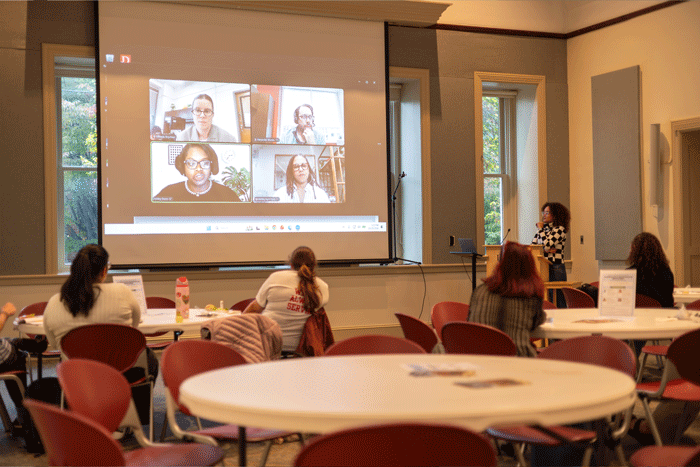
Photo by Alex Sonfield ’25.
PANEL EXPLORES ALTERNATIVE PATHWAYS IN EDUCATION
A highlight of the residency was the Alternative Pathways to Education Panel and Dinner Discussion, held Oct. 28 in the Stern Great Room. Moderated by Tejada, the panel brought together Dickinson alumni whose careers demonstrate the many ways an interest in education can lead to professional opportunities and social impact.
Panelists discussed career paths spanning teaching, consulting, leadership, human resources and organizational development, offering students a broader understanding of what working in education can look like beyond the traditional classroom.
“At the Alternatives to Education Panel, I learned more about education pathways that involve HR, leadership roles, and undergraduate enrollment,” said Maya Reichenbach ’27 (English and Spanish, creative writing minor).
Reichenbach also found inspiration in Tejada’s commitment to supporting others throughout her career. “Flow is passionate about uplifting those around her,” she said. “As a future educator, it was so inspiring to hear how she has been committed to restorative practices in each job title she has had.”
BUILDING CONNECTIONS THROUGH THE LIBERAL ARTS
Beyond the panel, Tejada’s residency created opportunities for students to engage with her through class visits, workshops and office hours. These conversations reinforced how a liberal-arts education can prepare students to pursue social change across a variety of professional settings.
Mary Charlotte Sterling ’25, who helped facilitate the panel, said Tejada brought together former Dickinsonians whose varied professional experiences illustrated the many directions an education-focused career can take.
“Flow’s message reinforced that there is no single path to creating change and that students can pursue meaningful work in ways that align with their own interests and passions,” Sterling said.
For Ha-DiMuzio, that message reflects the purpose behind the residency program: helping students recognize that everyone has a role to play in creating positive change.
“Social impact is not just for some select few; there’s a strategy of social change for everyone, whether it’s education, philanthropy, policy, research, or direct service,” Ha-DiMuzio said. “Everyone has a role to play in building just communities.”
Through its inaugural residency, CCLA demonstrated how connecting students with experienced community leaders can broaden their perspectives, strengthen their sense of purpose and help them envision new ways to make a difference.
TAKE THE NEXT STEPS
Published November 5, 2026