Show Your Work: Dickinson Students Bring Math to Universal Orlando

Students spent three weeks at Universal Orlando, all in the name of math! Photo courtesy of Dick Forrester.
There's a lot of math at work in amusement parks, and students recently explored it for three weeks
by Tony Moore
Trini Chung ’28 didn't sign up for The Mathematics of Theme Parks because she loved math. She signed up because she'd never been to Universal Orlando and figured a three-week trip over the summer sounded like a good time. Math, in fact, was the part the international business & management major had to brace herself for.
"The word 'optimization' jumped out at me as a little daunting," she says. But three weeks later, she was the one trying to explain optimization modeling to her friends back home—and getting blank stares in return.
That's the gap this course was built to close: the distance between math as something you do on paper and math as the engine driving decisions in the real world—theme parks included. For three weeks this summer, professors of mathematics Dick Forrester and Barry Tesman took a class of Dickinson students to Universal Orlando Resort and turned the entire park—its queues, its crowds, its Butterbeer carts—into a working lab. (Follow the students' day-by-day account.)
“I’ve always loved theme parks like Universal and Disney, but I also love mathematics, data science and optimization,” Forrester says. “This program was born from combining all of that—because it turns out theme parks are full of mathematical problems, and there's no better way to get students excited about them than to hand them a real problem and a theme park to solve it in.”
From Textbook to Turnstile
The math underneath a theme park is more substantial than most guests ever realize. Running a park efficiently means solving problems in optimization—building models that allocate staff, schedule shifts and route guests through a park in the way an airline routes planes or a delivery company routes trucks. It means statistical analysis—collecting real wait-time data to test whether Universal's posted times actually matched reality.
The course covered this ground, immersing students in probability, statistics, optimization, graph theory and combinatorics. (The course was modeled on Math & the Mouse, a similar program built around Disney rather than Universal by professors at Furman University, including Liz Bouzarth ’03, whom Forrester has collaborated with before.)
But the students didn't just hear about these ideas in a lecture hall. They tested them against actual wait times at rides like Hagrid's Motorbike Adventure, crowd data in Islands of Adventure and walking times they clocked themselves at the brand-new Epic Universe.
Optimization wasn't reserved for rides, either. Even choosing where to eat became a math problem: the group ran their restaurant votes through Borda count, runoff and Hare method tabulations to see how the outcome could shift depending on the voting system used.
Claire Muriceak ’29 (undeclared) says the shift changed how she understood math itself. She'd spent years doing problem sets in high school without ever connecting them to anything real. This was different.
“Doing math" had always meant practice problems and classroom lectures, she says—but at Universal, "we were more involved in hands-on mathematical learning experiences within the theme park."
The Butterbeer Problem
Ask Muriceak for the moment that defined the course, and she doesn't point to a lecture. She points to a cart.
Her group was tasked with finding the optimal route for a mobile Butterbeer stand to take through the park over the course of a day—a deceptively simple question that they tackled using clustering analysis and predicted wait-time data.
"My partner and I had to collaborate and take an initiative to come up with a different solution, even if it might not be the most optimal out of all our peers' ideas,” she says. “The tricky thing about real world applications, especially within this project, is that there are unpredictable factors that could affect an initial plan."
Overcoming the tricky things taught students a valuable lesson: real-world optimization rarely hands you a clean answer. Weather shifts. Crowds behave unpredictably. Posted numbers don't always match reality—a fact Muriceak now carries with her every time she visits a theme park and eyes a wait-time sign with new skepticism.
Meeting the People Who Do This for a Living
Midway through the trip, students sat down with Len Testa, co-author of The Unofficial Guide to Walt Disney World and founder and president of Touring Plans, a company that helps theme park guests plan their visits and minimize time spent waiting in line. Testa walked students through how he uses math and computer science to solve exactly the kind of problem the class would soon tackle themselves in the Three Park Challenge. For students, hearing it explained by someone who solves it professionally was a powerful validation of the coursework ahead.
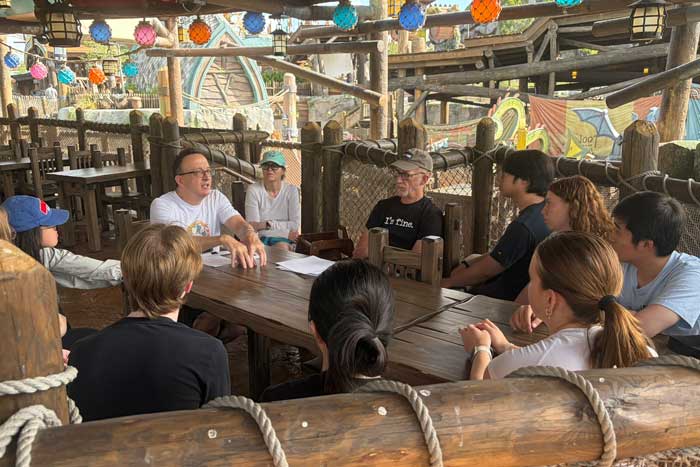
Len Testa, co-author of The Unofficial Guide to Walt Disney World, gives students the rundown on how he applies math and computer science to theme parks. Photo by Dick Forrester.
A few days later, the group traveled to the University of Central Florida's Hospitality Campus to meet Peter Weishar, a pioneering figure in themed entertainment and director of UCF's Themed Experience graduate program. Where Testa's world was data and optimization, Weishar's was storytelling: the developmental side of building a theme park, from concept art and architecture to the art of pitching an idea to a client. Students came away with something they didn't expect from a math class—genuine advice on how to pitch an idea, attentively answering their questions in a way several described as one of the most memorable conversations of the trip.
Between Testa and Weishar, students got a rare, two-sided view of the industry: the quantitative engine running underneath the parks and the creative vision that makes people want to stand in line in the first place.
Learning to Code, Learning to Trust the Process
For Chung, the breakthrough came through software, not a stand. Assigned to model employee scheduling, she learned to use FICO Xpress Mosel—an optimization tool she'd never encountered, doing something she'd never done before: writing her own program from scratch. Mention "FICO" to friends outside the program, she found, and they hear something else entirely. ("Like the credit score?" one asked.)
"When I finished programming—first time ever programming—and when I ran the software, it actually worked!" she says. What mattered more than the code running, she adds, was that she understood why: the process, the results, the conclusions she could draw from them.
It's the same type of optmization software Forrester has used to help assign incoming students to their First-Year Seminars—a detail that startled Chung when she learned it. The tool she'd just spent an afternoon wrestling with quietly shapes a decision every Dickinson student encounters.
“It was extremely gratifying to see our students learn, apply and put to actual use the mathematics being taught to them,” Tesman says.
Bringing It Home
By the end of three weeks, students had done more than complete problem sets. They'd built and defended research projects, kept a running class blog and—maybe more quietly—started seeing the world differently.
"Optimization finds a way into your everyday lives," Chung says, "but with that there are tradeoffs and unexpected turns of events." She's since caught herself asking, in situations that have nothing to do with theme parks, “Is there a more optimal way of doing this?”
Struck by the same instinct, Muriceak doubts she'll ever wait in a theme-park line again without doing a little mental math of her own. And Carter Strang ’29 (mathematics) will take that mental math on the road with him.
“After spending three weeks at Universal, I’ll never look at the wait-time app the same again,” he says, noting that the project helped him take a big step into understanding applied mathematics. “Now, whenever I go with my family, I’ll show them the most optimal routes to what rides we want to do.”
None of the students expected a math class to change how they see amusement parks—or, for that matter, everything else. But that was the idea all along: to prove that math isn't confined to a classroom.
Sometimes it's standing in line for a roller coaster, wondering why the sign says 20 minutes when it's been 35.
TAKE THE NEXT STEPS
Published July 28, 2026