Alums' Unique Practice Blazes a New Path in Rural Health Care

Stephen Reale '14, a physician, and Magdalena Niedermeyer ’15, a veterinarian, founded a mobile medical practice, delivering at-home care to humans and livestock in and near the Navajo Nation. When treating animals, Niedermeyer takes the lead and Reale is her assistant; the reverse is true when the patients are human.
Hooves & Hands cares for people, livestock in and near the Navajo Nation
by MaryAlice Bitts-Jackson
It started as a joke between Magdalena Niedermeyer ’15, a future veterinarian, and Stephen Reale ’14, an aspiring physician. “We said, ‘What if we’d set up practice together?’” says Niedermeyer. “There’d be a big building with a sign reading, ‘All are welcome!’ The human patients would go in on one side, and the animals would go in the other.”
That never happened, but the core idea survived—and evolved into a shared dream. Today, this husband-and-wife team operates Hooves & Hands, a mobile medical practice serving people and animals living in and near the Navajo Nation. It is the only known venture of its kind, and it meets a critical need in rural southeastern Utah.
From ‘why not?’ to 'how?'
Niedermeyer and Reale are native New Englanders who met on Dickinson’s campus in 2011. She majored in English and biology, with plans to become a veterinarian, like her parents. He double-majored in music and neuroscience, a composer eyeing a neurology career.
“We took long walks and talked about everything,” remembers Niedermeyer. She challenged him to become more decisive and illuminated the ‘hows?’ to her ‘why nots?’.
After Dickinson, they attended Tufts University—he earned an M.D., specializing in family practice, and she became a large-animal vet. They moved to southeastern Utah, where access to health-care facilities can be a long drive from rural homes and where veterinarians are even more scarce.
Improving patient outcomes
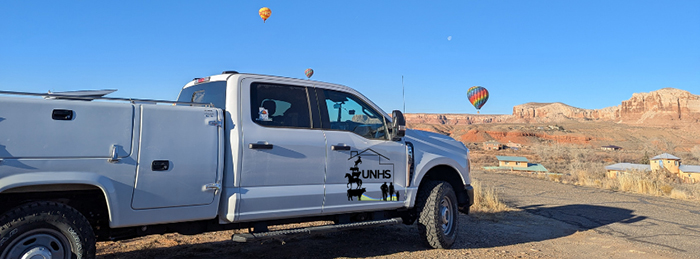
Employed by the Utah Navajo Health System, the couple drives a truck, outfitted with supplies to care for animal and human patients, to several remote farms each day.
Employed by the Utah Navajo Health System, Niedermeyer and Reale drive a truck—outfitted with essential supplies—to several remote sites every day. At one stop, they might help a human with a chronic condition or a cold. Then, they might vaccinate sheep or set a goat’s leg.
During veterinary visits, Niedermeyer takes the lead and Reale assists her; the roles reverse with human patients. Occasionally, they’ll tend to human and animal needs at the same farm.
Reale, a self-described “city boy” from outside Boston, faced the biggest learning curve, having never handled farm animals before. “The first time we worked with a horse, she told me to hold it still, but it just walked away, with me holding the lead,” Reale remembers with a laugh.
Improving patient outcomes
The day’s first appointment can be an hour or more from home, with long drives between subsequent visits. For large-animal vets, this is not unusual, but for general practitioners, it’s rare.
Reale says it’s worth it: “Any doctor who does home visits will tell you that the opportunity to see people in their everyday surroundings affords a real window into people’s lives that working in an office doesn’t. That can improve quality of care—and improve patients’ lives.”
Another benefit: Some patients are more likely to seek care when they’ve already booked a veterinary appointment. Recently, while the couple tended to animal patients, a homeowner told Reale that her husband had been having difficulty breathing. Reale did an exam on the spot and developed a treatment plan.
Blazing a path
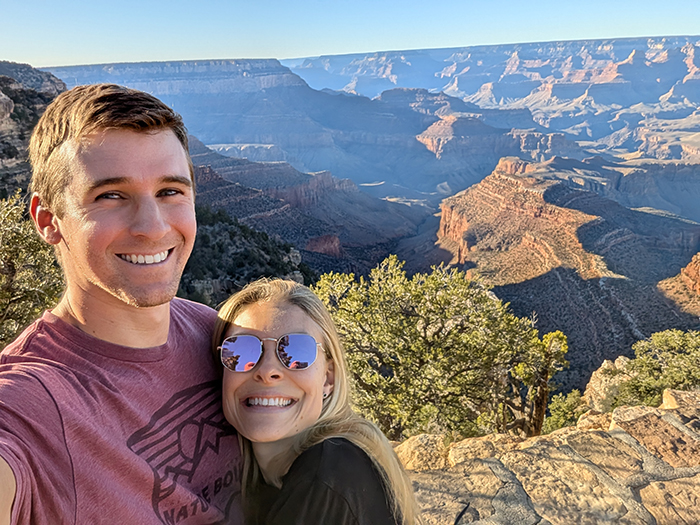
At-home care requires a high level of trust, so the couple gets to know their patients and takes care to build strong ties. Reale says it’s partially about acknowledging that, while they are the medical experts, the patients are the experts of their own bodies and lives, and they have a say in their treatment.
“It’s also about treating people as people,” says Niedermeyer, noting that while they’re making an effort to learn Navajo language and culture, patients’ core concerns are universal. “We try to treat everyone like our own family.”
Of course, none of it would be successful if the doctors couldn’t handle the shifting responsibilities; continuous learning across two fields and countless hours together on the road. For them, it’s both a challenge and a joy to plant roots in this uncommon way.
“I love getting to have every day as a unique adventure where I’m being useful to people, and I love that I’m doing this with Stephen,” Niedermeyer says.
“We didn’t really have any path to follow,” Reale adds, “so we’re blazing our own path.”
TAKE THE NEXT STEPS
Published April 21, 2026