What’s in That Glaze? Students Bring Scientific Method to Community Ceramics

To help local ceramicists make informed decisions about how their works may be used, Dickinson chemistry students are testing how ceramics glazes used at the Carlisle Arts Learning Center perform under test conditions. Photo by Dan Loh.
Findings will help inform artist decisions about stoneware used for food, drink
by MaryAlice Bitts-Jackson
Dickinson chemistry students are partnering with a community arts center to test glazes used by local ceramicists. Their findings will help artists make better-informed decisions about pieces intended for food and drink, while providing the students with an opportunity to conduct meaningful scientific research.
Science meets ceramics
The student-faculty project is led by Associate Professor of Chemistry Sarah St. Angelo. During a recent sabbatical, she took ceramics lessons at the Carlisle Arts Learning Center (CALC) and learned that CALC instructors do not endorse all of its glazes for foodware because they could not confirm whether some glazes might release metals during normal use.
This isn’t unusual. Ceramics glazes in community studios are often mixed from traditional recipes that haven’t been formally tested.
Both traditional and commercially produced glazes contain glass-forming materials, fluxes and stabilizers that melt and fuse to the surface of a ceramic work during firing. Small amounts of metals are often added to produce color—copper for greens, cobalt for blues, iron for browns. This is less of a concern for decorative pieces, although these metals can be used for foodware when they are properly bound in the finished glaze.
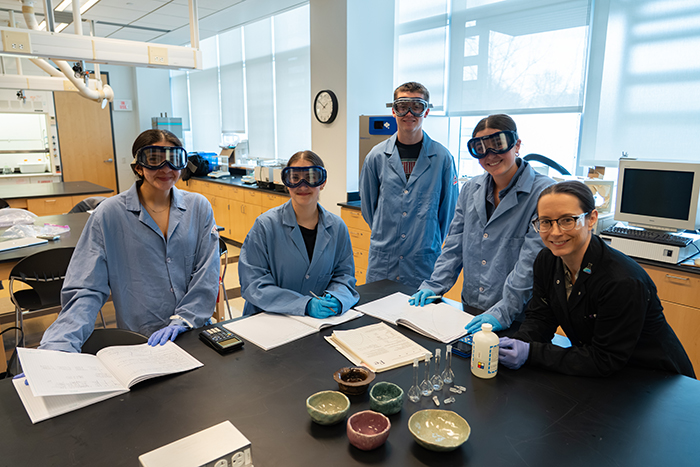
Several of the student researchers on the eight-person team meet with Associate Professor of Chemistry Sarah St. Angelo (far right) in the lab. Each completed extensive training on safety protocols and lab equipment. Photo by Dan Loh.
St. Angelo limited the scope of the current project to one question: How do the glazes used at CALC perform under conditions the FDA uses to test ceramics for food safety?
Setting it up
To prepare for the work, St. Angelo and two upper-level students analyzed raw glazes used by CALC and confirmed which metals were present and in what amounts. Now, eight additional students are testing whether the metals in finished glazes are released under test conditions, and if so, at what levels.
The team is using a modified protocol based on food-safety guidance from the U.S. Food and Drug Administration for testing for lead and cadmium, metals CALC does not use in their glazes. Because the FDA does not set standards for ceramic glazes beyond lead and cadmium, the researchers are adapting those guidelines to evaluate potential metal leaching.
‘It’s getting exciting’
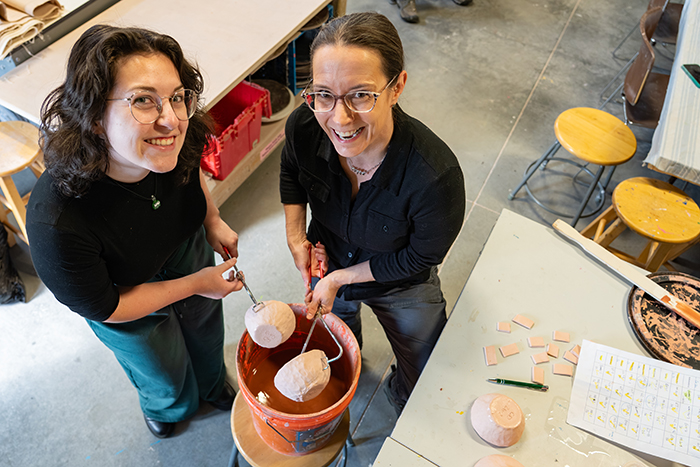
Colleen Duffy ’26 (chemistry, neuroscience, left) conducted preliminary experiments with Associate Professor of Chemistry Sarah St. Angelo (right). Photo by Dan Loh.
The first step: The students completed a 17-hour American Chemical Society lab safety certification course and learned how to use lab instruments. Then they created test vessels in CALC’s studio and coated them with glazes. Because glaze samples in a shared studio environment can vary in composition—whether because sediments that settled at the bottom were not thoroughly mixed or because of cross-contamination within the studio—each student made multiple vessels.
Next, the students filled bowls with 4% acetic acid and let them sit for 24 hours at room temperature. The students are now testing the solutions with an atomic absorption spectrometer, looking for measurable levels of metals.
“We can’t definitively say whether there are no metals present, because our equipment will not detect trace amounts under a certain level,” clarifies St. Angelo. “But we can say what we see and provide context for what a level of concern would be.”
Variability emerged out of the gate: One of the vessels was coated with a glaze intended to produce a blue tint, but it appeared dark brown instead—possibly because the glaze hadn’t been stirred thoroughly. “It’s interesting, because we’re seeing results we weren’t expecting,” says Hunter Brown ’29.
“It’s definitely getting exciting as we really get into the experiments,” agrees Erin Miller ’29 (chemistry).
Rare opportunities
Once testing and analysis are complete, students will translate the findings for a nonscientific audience. Some will present what they learned to CALC representatives so the results can inform decisions in the studio.
St. Angelo intends to continue student-faculty research in this area in coming semesters, diving into follow-up questions such as: Does mixing multiple glazes alter the results? Do variations in kiln temperature, placement or firing time affect a glaze’s chemical composition?
She says this project is especially thrilling because it’s rare for research scientists—let alone undergraduate science students—to witness the direct and immediate effects of their work.
The significance isn’t lost on Colleen Duffy ’26 (chemistry, neuroscience), who conducted preliminary tests for the current project, along with other student-faculty research. “This is an interesting, interactive, interdisciplinary project,” Duffy says, “and it’s really cool to know that we’re able to help local artists right here in Carlisle.”
TAKE THE NEXT STEPS
Published April 8, 2026