Taking the Stage at the National ACS Meeting

Chemistry students present original research at one of the discipline’s largest national gatherings
by Tony Moore
For most undergraduates, chemistry happens in a lab somewhere in the depths of a campus building. For 10 Dickinson students this spring, it happened on a national stage—in Atlanta, at the American Chemical Society’s (ACS) Spring 2026 national meeting, one of the largest gatherings of chemists in the world.
The students traveled with Associate Professor of Chemistry Rebecca Connor, Assistant Professors of Chemistry Miguel Leal and Olivia Wilkins and Visiting Assistant Professor of Chemistry Krishna Donavalli, each presenting original research alongside thousands of professional scientists.
Ownership in the Lab, Confidence on the Floor
The ACS national meeting draws researchers from across academia, government and industry, and for students accustomed to presenting within the college, the scale can be striking. But according to Connor, Dickinson students are better prepared for that moment than they might realize.
“Our students develop ownership over their research projects through their work in the lab directly with us,” says Connor, who, along with Leal, delivered a talk. “That ownership translates to confidence when they are presenting and discussing their work. Many students come away from conferences excited about new ideas they have gained from their conversations and symposia they attended.” (Some of those conversations were with Dickinson alumni, as the group had dinner while in Atlanta with Marjorie Speers ’78 and Peter Andersen ’73, P’13—a reminder that the Dickinson network welcomes students far beyond Carlisle.)
The conference also gave students a rare window into where the discipline is heading. Thomas Borne ’27 (chemistry) attended a presentation by Nobel laureate David MacMillan, an experience he described as one of the trip’s defining moments.
“The highlight of the conference was the amazing opportunity to see presentations from some of the most accomplished chemists in the world, and experiences like this allow students to engage and learn from these figures in a way unavailable to many students otherwise,” he says. “Attending and presenting a year of research felt like a keystone piece of my research experience as a whole, and it has elevated my work and my confidence as a researcher.”
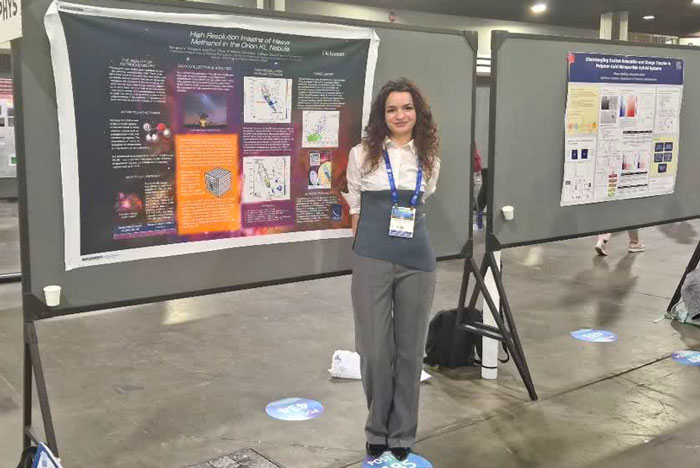
Boriana Yotzova '26 presents work that she published earlier this year in the journal "ACS Earth and Space Chemistry."
The Flow of Knowledge
For Vincenzo Randazzo ’27 (biochemistry & molecular biology), the value of the conference was as much about connection as content. Presenting to a broader audience—fielding questions, engaging with diverse perspectives—helped him see his work in a larger context and begin building the kind of professional network that sustains a research career.
“Attending the presentations was both exciting and motivating, while also providing inspiration for future research projects on campus,” he says, noting that he met chemists whose work he’s followed closely. “And presenting at a national conference has enhanced my Dickinson experience by helping me build a professional network within the scientific community.”
Eve Kratzer ’26 (chemistry, biochemistry & molecular biology), who will head to the University of Kansas in the fall to pursue a Ph.D. in pharmaceutical chemistry, reflected on what it meant to share her research with scientists who could push it forward—even as she prepared to pass the project to the next generation of Dickinson researchers.
“I was able to share my work and excitement about my project with other scientists who were able to give me ideas about next steps and possible innovations,” she says, adding that the trip brought her closer to the people she went with but also deepened her appreciation of her own research. “I’m graduating, so I won’t be able to act on those ideas, but I’ve been able to pass them on to other researchers who are adopting the project. The flow and exchange of knowledge has made me appreciate Dickinson for giving me the opportunity to talk with chemists in the field.”
Research Presented
In all, 10 students presented five projects across an array of topics:
Eve Kratzer ’26 (with Prof. Connor)
- “Production of halogenated phenylacetylenes for synthesis of Hsp70 inhibitors”
Thomas Borne ’27 and Vincenzo Randazzo ’27 (with Prof. Leal)
- “Synthesis and characterization of sulfonamides via germylamine defluorination”
Millia Martinez ’28 (physics), Silvia Roberto ’29 (chemistry) and Boriana Yotzova ’26 (chemistry) (with Prof. Wilkins)
- “Building a cosmic ice experiment at a small liberal arts college” (Martinez, Roberto)
- “High-resolution imaging of deuterated methanol in the Orion KL Nebula” (Yotzova)
Will Anderson ’28 (chemistry), Abby Duffy ’27 (biochemistry & molecular biology), Noah Morginstin ’28 (chemistry, biochemistry & molecular biology) and Stephanie Kim ’28 (biochemistry & molecular biology) (with Prof. Donavalli)
- “Indole-based small molecules: A rational synthetic framework for addressing antibiotic resistance”
TAKE THE NEXT STEPS
Published April 13, 2026