February Lectures Explore the Arts, Democracy, Social Justice, AI

The Dickinson College arch.
Talk on the arts and democracy headlines February public events
Dickinson's February 2026 public lectures reach into the current moment in thought-provoking ways. They begin with a Black History Month discussion of the psychology of belonging and identity and continue with a book talk by an alumnus author on the fight for gay rights. The month's highlight is a lecture on the role of the arts in democratic society. February closes with a panel discussion on the real-world effects of artificial intelligence.
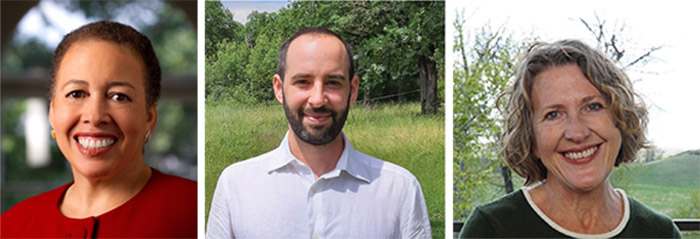
From left: Beverly Daniel Tatum, president emerita of Spelman College; Michael Stambolis-Ruhstrofer ’04, author and sociologist, University of Toulouse; and Shannon Jackson, author and professor, UC Berkeley
Tuesday, Feb. 3, 7 p.m.
Black History Month Conversation: The Psychology of Belonging: Navigating Identity on a College Campus
Beverly Daniel Tatum, president emerita of Spelman College
Anita Tuvin Schlechter Auditorium
The esteemed psychologist, scholar and former president of Spelman College joins a moderated conversation inspired by her New York Times-bestselling book, “Why Are All the Black Kids Sitting Together in the Cafeteria?” And Other Conversations About Race. Learn more: "Beverly Daniel Tatum to Headline Black History Month Events at Dickinson."
Monday, Feb. 9, 5 p.m.
By the Power Vested in Me: A Book Talk With Michael Stambolis-Ruhstrofer ’04
Stern Center, Great Room
Michael Stambolis-Ruhstorfer is a sociologist, an associate professor of American studies at the University of Toulouse, a junior member at the Institut Universitaire de France and a member of Dickinson's class of 2004.Through the story of the fight over gay rights, his book reveals how and why some experts, but not others, obtain the authority to shape public opinion and policy and offers new ways to understand the contested apolitical role of expertise and its consequences. This program is sponsored by the departments of French & Francophone studies, sociology and women’s, gender & sexuality studies; the LGBTQ+ Center; and the Clarke Forum for Contemporary Issues. Learn more about this event.
Tuesday, Feb. 17, 7 p.m. 
Phi Beta Kappa Visiting Scholar Program: Democracy and the Arts
Shannon Jackson, UC Berkeley
Anita Tuvin Schlechter Auditorium
Shannon Jackson, a scholar at the University of California, Berkeley, will discuss how art is used as a tool to explore and engage with politics, social movements and democratic practices. She will also explore examples of socially engaged art and how art can expose inequities, and she will ask whether the arts should play a role in politics or whether art should remain strategically “un-useful.”
Jackson is a professor of arts & humanities, a Phi Beta Kappa Visiting Scholar, the Cyrus and Michelle Hadidi Professor of the Arts & Humanities and the chair of the art history department at UC Berkeley. She also leads the university's Environmental Arts & Humanities Initiative. Previously, she served as UC Berkeley’s associate vice chancellor for the arts and design. Jackson is the author of several books, most recently Back Stages: Essays Across Art, Performance and Public Life (Northwestern University Press, 2022), Social Works: Performing Art, Supporting Publics (Routledge, 2011) and The Human Condition: Media Art From the Kramlich Collection (Thames & Hudson, 2022). She and her work have been recognized through awards and grants including through the Mellon Foundation, a 2015 John Simon Guggenheim Fellowship and a fellowship from the National Endowment for the Humanities.
This program is sponsored by the Phi Beta Kappa Society’s Visiting Scholars Program and the Clarke Forum for Contemporary Issues. It is also a part of the Clarke Forum’s annual theme, Thought Experiments. Learn more about this event.
Thursday, Feb. 26, 7 p.m.
Panel Discussion: Real-World Effects of AI
Anita Tuvin Schlechter Auditorium
This panel explores what the AI boom means for all of us. The speakers will discuss a variety of applications of generative AI and the ethical concerns that arise through them, ranging from AI's effects on scientific research, health care diagnostics, automated content creation, public utilities and the environment. This program is presented by the Clarke Forum for Contemporary Issues and is part of the Clarke Forum’s Leadership in an Age of Uncertainty series.
For additional information about any of these events, please visit clarkeforum.org or email clarkeforum@dickinson.edu.
TAKE THE NEXT STEPS
Published January 28, 2026