Tradition Lives Here

by MaryAlice Bitts-Jackson
Nothing charms Dickinsonians quite like our mermaid and her storied home, Old West. We know because we asked: The top two answers to our alumni-newsletter poll about Dickinson traditions? Signing in and out of the college and processing on the Old West steps. A sentimental favorite among alumni of a certain age? Seizing the mermaid—and the accompanying lifetime bragging rights.
But how much do you know about the oldest building on our land-locked campus and the improbable mermaid atop it? This is a story about the history, thrills and profound cultural shifts driving three beloved Old West traditions.
The wild Old West
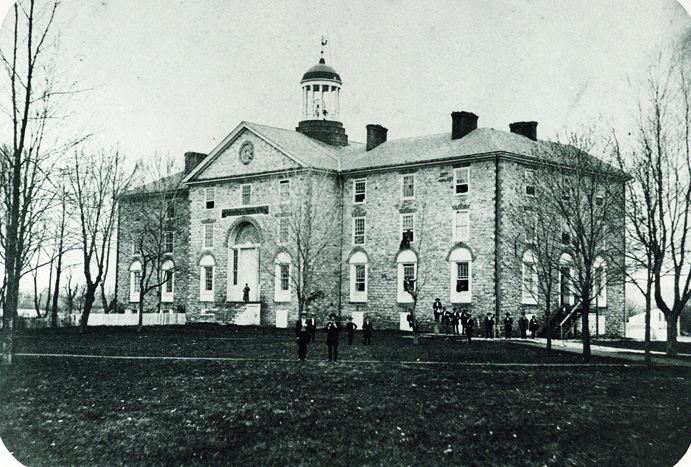 Dickinson’s first building, New College, took three years to construct—and only two months to burn to the ground. Its replacement, West College, was designed pro bono in 1803 by Benjamin Latrobe, architect of D.C.’s Capitol building. It was dubbed “Old West” sometime after East College was erected in 1836.
Latrobe’s original drawings didn’t include a cupola, but he added one to house the all-important school bell. Inspired by classical motifs, he drew a weather vane in the shape of a triton, or merman, to top it. According to college lore, a local metalsmith instead fashioned a mermaid—the only mythological sea creature he knew.
Old West housed students and some faculty members and hosted classes and chapel services. Trifling fires ignited brief excitement in 1820 and 1836; another, in 1844, was efficiently extinguished by bucket brigade. Confederate forces occupied the grounds in 1863. After their departure, Old West was used as a makeshift hospital.
Faculty moved out in 1890, but students remained until the early 20th century, when Bosler Hall was completed. Memorial Hall was dedicated in 1919 to Dickinsonians who perished in World War I.
“That’s when Old West became regarded as a more sacred space—a space that has seen so much history, where special activities are held and administrative tasks are performed,” says College Archivist Jim Gerencser ’93. A potent symbol of this collective shift is Old West’s evolving role in Commencement.
Upstairs, downstairs
Dickinson’s first graduation—a public celebration, with lengthy speeches by all five graduates—was staged at a nearby Presbyterian church. Commencement then moved to various spots until 1962, when Old West became Dickinson’s official graduation site.
Graduates have processed through Memorial Hall and down Old West’s steps since 1967.
“You walk out to the crowd—so nice. There’s a sense of finishing a stage of life,” wrote Chris Kennedy ’85, responding to our poll.
“You realize the role you’re playing in the college’s history,” added Stacy Bartels ’85, P’21.
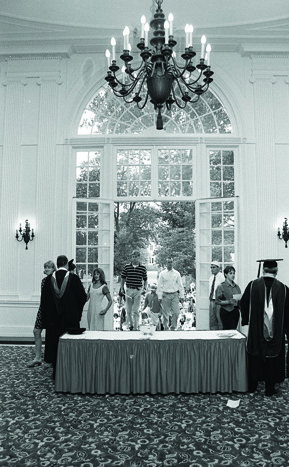 That’s why cloudy skies alone won’t send Commencement indoors. Some classes, like 2013, have graduated under umbrellas. Others, including 1990, have processed straight from an indoor ceremony to the dampened “old stone steps.” During the pandemic-era disruptions of 2020 and 2021, the college postponed—rather than canceling—the tradition, by student demand. The corresponding Convocation custom—walking up the Old West steps and signing in to the college—draws from an early administrative procedure. From the mid-1800s to early 1900s, students signed in to the college as they arrived on campus for each new academic year. Signatures denoted enrollment and a pledge to obey college rules. In the early 1900s, the handwriting became uniform, as the registrar signed each student in.
The college folded student signatures into Convocation in 1995. Prior to the ceremony, the new students signed pledge cards. After processing up the “old stone steps,” they placed the cards in a silver bowl. The tradition was tweaked in 1999. Ever since, students have signed their names during the ceremony after entering Memorial Hall. Together with the Commencement procession, this tradition formally connects students to the college’s history and bookends their time on campus.
Daredevil Dickinsonians
Old West is also home to a much wilder tradition—this one surrounding our prized mermaid weather vane. Measuring just 34 inches tall, our “lady of Old West” has been an outsize character in the Dickinson narrative since her arrival in 1807. As Charles Himes, class of 1855, once wrote, she’s made some “smile half-apologetically,” on mention, because she seems out of place. Many more have reveled in her uniqueness and misshapen charm. And some even took audacious risks to “steal” her, as part of a daring, student-driven tradition.
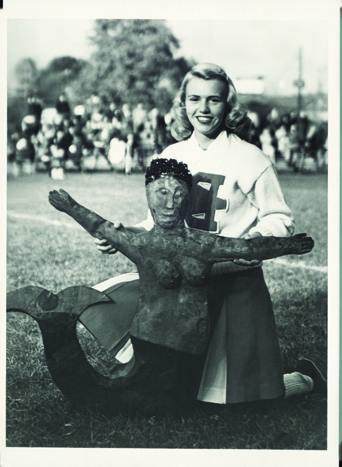 Pranks such as these were once common at colleges, beginning in our nation’s earliest days. At Dickinson, Old West-related pranks initially revolved around stealing the college bell, which moved from Old West to Denny Hall in 1905. Attention shifted to the mermaid in 1915.
Back then, the college chaplain was a favorite prank victim. After absconding with his bicycle, Alpha Chi Rho brothers attached it to the mermaid. The chaplain’s ride was retrieved by steeplejacks the following day. Few knew how the pranksters managed it—until Frank Masland, class of 1918, spilled the beans through a 1977 Dickinson Alumnus exclusive. First, they carried the bike up to the Old West attic. Unable to fit it through the ceiling’s trapdoor, they disassembled the bike, passed the parts through and reassembled it on the belfry. Then, hugging the pillars, they stood on each others’ shoulders, creating a human ladder. One climbed up to the cupola. His brothers tossed him a rope, affixed the bike to it, et voila!
Countless mermaid-napping attempts followed.
“The legend was that, if you were a class with any kind of spirit or gumption, someone would steal that mermaid,” recalled Howard Kave ’69. He became an unwitting accomplice one night, when he returned to Malcolm Hall and discovered the mermaid under his bed. Despite dubious rumors of leaps to the cupola from a nearby tree, no students were known to be seriously injured.
Over time, the pranks were baked into Homecoming: After her capture, the mermaid was ceremoniously returned between halves of the big game. The tomfoolery escalated in 1957. As reported in The Dickinsonian, first-years not only pilfered the mermaid but also the bell-clapper; President Edel’s birdbath, portrait and chair; Vice President Malcolm’s chair; several podiums; a bust, bench and moose head; and a bounty of Morgan Hall toilet seats. (Most items were returned—some to the president’s porch.)
Escalation and transformation
The tradition lost some sheen in 1967, when a first-year dropout or expellee spirited the mermaid off to a New York City apartment. He planned to sell her to a Paris art dealer. College leaders caught wind and explained to his parents that this would be a federal crime. The mermaid was returned the next day, and it never topped Old West again.
After those exploits, a master craftsperson recommended by the director of Colonial Williamsburg created a 2D replica to top the cupola. The original mermaid was placed on a pedestal in the library’s May Morris (now East Asian Studies) Room.
In 1986, Acting President George Allan commissioned a 3D replica, which remains atop Old West today. “Dickinson without a mermaid was like morning without orange juice,” Allan later wrote, characterizing her return to Old West as a crowning achievement of his one-year presidency. Electronic security systems foiled a mermaid-napping attempt in 2002; they’ve deterred would-be miscreants ever since.
Finally, in 2000, the original mermaid found a more visible home—inside the main doors of the library. You can still see her there.
And so, for 188 years and counting, the beloved mermaid, in one form or another, has overseen Commencements and Convocations; Civil War; proposals, weddings, reunions and protests; alfresco study sessions; seedlings unfurling into wizened trees; and, yes, a plethora of prankery.
While she may hold special allure for alumni who remember the pranks, her appeal is truly multigenerational and her traditions thrive in new forms. Always camera-ready, she’s a social-media darling and a featured stop on every campus tour. Her image appears on campaign materials, social media and Dickinson Outfitters merch, and she’s the namesake for our largest giving society and our venerable campus theatre group.
Read more from the fall 2025 issue of Dickinson Magazine.
TAKE THE NEXT STEPS
Published December 1, 2025