Sweet Victory: Dickinson Students Claim Award at World’s Largest Collegiate Hackathon
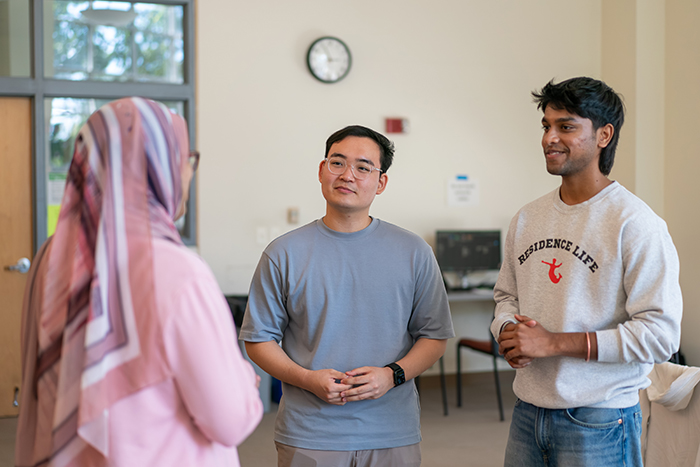
Dickinson juniors John Lee (center) and Hemanth Kapa (right) chat with Assistant Professor of Computer Science Farhan Siddiqui. Photo by Dan Loh.
Outnumbered and undeterred, friends channel tech skills to help patients manage chronic disease
by MaryAlice Bitts-Jackson
San Francisco's Palace of Fine Arts echoed with the rhythms of 2,000 clacking keyboards as competitors raced against the clock at Cal Hacks 2025. Huddled over their devices, Hemanth Kapa ’27 and John Lee ’27 battled spotty Wi-Fi, unfamiliar tech and a 48-hour deadline to create their diabetes-management app. Their persistence paid off: They captured the Best MCP Automation Challenge award from the world’s largest collegiate hackathon.
For Kapa and Lee, this was more than a coveted endorsement. It was another step toward their goal of helping to better the world through tech.
The dynamic duo
Kapa double majors in computer science and neuroscience and comes to Dickinson from India, and Lee is a computer science and math double major from South Korea. They met during a training session for resident advisors and discovered a shared interest in biotechnology. Through separate internships, Kapa is working on a graphical interface scientists can use to study cell membranes, and Lee recently helped develop software for surgical machinery.
They’re no strangers to hackathons—short, intense competitions bringing teams of coders and designers together to create tech projects from scratch and present them. Kapa’s first was in 2019, when he was a high-schooler in India. Soon after, he helped bring two hackathons to his hometown, which attracted roughly 120 participants each. Lee attended HopHacks (hosted by Johns Hopkins) and PennApps (University of Pennsylvania) earlier this fall. At PennApps, his team won the Most Creative Track award for a game using Gemini API's image detection technology.
When Kapa learned Lee was planning to participate in Cal Hacks, he was all in. Hosted by the University of California, Berkeley, and attracting big-name sponsors like Amazon and Anthropic, Cal Hacks is renowned for helping to launch startups and tech careers.
This time, it's personal
Kapa and Lee planned to create an app that would make diabetes management easier. Typically, people with diabetes use multiple tools several times daily to keep their blood sugars on track—a frustration that Kapa knows all too well. “It can be overwhelming,” says Kapa, a Type I diabetic. “We wanted to build a conversational assistant that could make managing diabetes as easy as texting a friend.”
The students envisioned a tool that would allow users to monitor glucose, determine and record nutritional information and calculate recommended insulin dosage using one intuitive, chat-based system. With funding from a Dickinson Career Development Grant, Lee and Kapa traveled to San Francisco to build it from scratch, under pressure and under deadline. Cal Hacks was held Oct. 24-26.
Hacking through challenges
More than 3,300 hackers registered for the event, including about 2,100 in-person competitors, and about 700 projects were submitted.
The average team had four or five members—a distinct advantage over the Dickinson duo. Adding to the challenge: Because of the sheer number of competitors, Wi-Fi was spotty inside the auditorium, where the teams’ tables were set up. Kapa and Lee moved their laptops outside of the auditorium, connected to their own hotspot and got to work.
The students decided to build a Model Context Protocol (MCP) server that would integrate with a variety of existing digital tools, including Kapa's Dexcom glucose monitor. But because of the protocols and security requirements surrounding medical data devices, medical application programming interfaces (APIs) are notoriously difficult to work with. Kapa and Lee spent nearly 12 hours just trying to connect the MCP to the live data feed. Another big hurdle: They'd never built on MCP before.
Learning on the fly, they used Python to build custom modules for insulin calculation algorithms, carb-ratio management and pattern-recognition logic. Connecting with Gemini's API, they made it possible for users to seamlessly calculate and track nutritional information simply by snapping a photo of the food they were about to eat. They built in the capability to send automatic texts to a user’s emergency contacts should the user’s blood sugar go too high or too low, based information the user inputted during app setup.
“It was definitely one of the most challenging projects I’ve done,” says Lee. “But that’s also what made this project so interesting and rewarding. We were using real, live data from Hemanth’s glucose monitor, not just some random dummy data. This means our solution can actually help Hemanth and other people with diabetes in a meaningful way, and we could verify in real time that it was working correctly.”
The 'amazing journey' continues
Fresh from their win, Kapa and Lee continue to test their open-source prototype, and they're exploring other platforms and glucose-monitoring tools and functionalities. Developers and others are free to check it out, but they caution people, especially those with diabetes, to wait until the product is launched and fully tested before using it regularly.
“Our goal is to build something that genuinely helps people. Safety always comes first,” Kapa says.
Both students recommend the whirlwind hackathon experience. It sharpened career-ready skills, like learning fast, collaborating effectively under pressure and pitching ideas. They also met people with similar interests, including potential mentors. The fact that they received a coveted vote of confidence adds even more excitement to the mix, observes Lee.
“Winning or placing at Cal Hacks is really meaningful, and it felt great to be part of it,” Lee says. “I’d like to express my sincere gratitude to the Dickinson career center for funding this amazing journey, Their support made it possible for us to gain an invaluable experience that could shape our careers.”
TAKE THE NEXT STEPS
Published November 20, 2025