Skip To Content Skip To Menu Skip To Footer

Workday

Dickinson Selects Workday for Finance, HR, and Student System

In our continuous effort to enhance administrative efficiency and advance Dickinson’s strategic goals, Dickinson has transitioned to Workday for finance, human resources and payroll, replacing Banner as our core administrative system in these areas. The College is continuing this multi-year initiative with the implementation of Workday Student, which will replace Banner for student information management. This ongoing effort reflects our commitment to providing modern, integrated technology solutions that meet the evolving needs of our students, faculty and staff.


What Is Workday?

Workday is a comprehensive, cloud-based system that consolidates Human Capital Management (HCM), Finance, Payroll, and Student information into a single, inclusive platform. It is designed with a modern, user-focused interface that supports efficient completion of everyday tasks. With real-time access to important data, Workday will enable faculty, staff, and students to get the information they need quickly and easily. Its flexibility also means that the system can grow and adapt as our needs change.


Project Goals


Modernization: Implement a scalable, cloud-native system that consolidates applications, supports institutional growth, and positions the college to leverage emerging technologies that meet the evolving needs of the campus community.  

System and Data Security: Ensure a secure, compliant system that safeguards institutional data, protects privacy, and adheres to security and regulatory compliance.

Operational Efficiency: Streamline and automate business processes to increase operational efficiency and reduce administrative overhead for all institutional stakeholders.  


Enhanced Decision-Making and Analytics: Empower campus constituents with real-time analytics and role-based reporting tools that enhance data driven decision making, support strategic planning, and provide insights into how institutional efforts contribute to the student experience and overall success.

User Experience and Adoption: Deliver an intuitive, mobile friendly user experience that encourages widespread adoption, enhances faculty, staff, and student interactions with administrative technology, and fosters productivity. 


Timeline

The Workday implementation began in January 2025 with the transition of core Finance, HCM and Payroll functions from Banner to Workday. These areas successfully went live in late 2025, followed by the implementation of Adaptive Planning, Workday’s budgeting and forecasting solution. The next phase of the initiative is Workday Student, which begins in fall 2026 and will include a phased rollout in 2028.

Finance and Human Resources (Jan. 2025 – Jan. 2026)

From January 2025 through January 2026, Dickinson’s project team worked through the planning, configuration, testing, and deployment of Workday for Human Resources, Payroll, and Finance. The project is now live, and the team has transitioned to ongoing support and continuous improvement.

Preparation - Workday Student (Sept. 14 – Nov. 14, 2026)

The preparation phase for Workday Student begins September 14, 2026, marking the start of Dickinson’s journey toward implementing Workday Student. During this phase, the project team will focus on process review, data preparation, and technical readiness to establish a strong foundation for the implementation ahead.

Planning (Nov. 16 – Jan. 31, 2027)

The planning stage launches the Workday project and establishes the roadmap for its success.  During this stage the project scope is reviewed, and project management tools and processes are established. The team begins Workday training and builds a Foundational Tenant so that we can prepare for configuration when seeing familiar Dickinson data in Workday.

Architecture & Configuration (Feb. 1 – Jul. 31, 2027)

The architect and configure phase focuses on designing and building the future state of the system. This includes configuring business processes, reports, security roles, and system integrations. Additionally, the team works on establishing processes for converting legacy data into the new system.

Test (Aug. 1 – Dec. 31, 2027)

The testing phase is a crucial part of the project where the team thoroughly validates the system design through various testing activities. This includes end-to-end testing to ensure workflows function seamlessly, mock registration to verify class registration works as expected, regression testing to confirm existing processes work after updates, and user acceptance testing to gather feedback from end-users. Each type of testing plays a vital role in ensuring the system is robust and ready for deployment.

Deployment (Jan. 1 – Sept. 31, 2028)

The deployment phase emphasizes readiness for implementation, including finalizing the production system and migrating legacy data into the new platform. This phase also focuses on training end-users to ensure they are prepared to effectively use the new system.  We have four go-live benchmarks during this time (approximate dates below):

Feb. 1, 2028:

  • Academic units and levels
  • Student core
  • Programs of study
  • Calendars
  • Educational institutions
  • Curriculum
  • Student conversion
  • Financial Aid Inetegration
  • Admissions Integration
  • Advising

Apr. 1, 2028:

  • Registration
  • Fee calculations, sponsors, and waivers
  • Payments
  • Casheiring 
  • Payment plans

Aug. 1, 2028:

  • Disbursement

Oct. 1, 2028:

  • Student financials balances
  • Grading
  • Graduation
  • Transcript generation
  • End of term processing
Post-Production Support and Optimization (Oct. – May. 2029)

The system is monitored to ensure it works as expected and teams begin to emphasize continuous improvement, system stabilization, and enhancing functionality.


Guiding Principles

The Guiding Principles act as guardrails to keep key decisions and solutions aligned, consistent, and focused on achieving the project’s goals.

  • Workday First: We will look to Workday first, utilizing the capabilities already available within the Workday system before exploring the need for additional systems or integrations for Finance, Human Capital Management, and Student operations.
  • Process Design and Improvement: We will design efficient, user-focused business processes which reduce administrative overhead and support faculty, staff, and students in completing their work efficiently. We will seek to implement best practices and procedures as recommended and delivered by Workday.
  • User Experience: We will design for simplicity, user-friendliness, and efficiency using inclusive and accessible outreach and training.
  • Communication and Collaboration: Consistent and clear communication is essential for the success of our Workday implementation and for ongoing enhancements once the system is live.
  • Change Management: We will remain open to growth and change, distinguishing true college priorities from unique preferences. This will involve careful listening, meaningful discussions, and thoughtful decision making.
  • Strategic Focus: We will design the system with our future needs in mind, not only today’s.

Governance

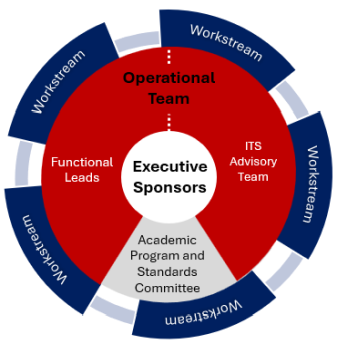
diagram showing workday govenance

The governance framework ensures clear and collaborative decision making as we transition to Workday. This structure is designed to enable quick insightful project decisions while fostering alignment with institutional priorities, transparency, and effective problem resolution.

Key governance groups include:

  • Workstream Core Teams: These teams manage daily project tasks, configure processes, and make the day-to-day project decisions. They review and adapt current business practices, test new processes, and escalate unresolved issues to the Operational Team.
  • Operational Team: Composed of functional leads and IT advisors, this team oversees department-level and cross-departmental workflows and resolves issues escalated by the Workstream Core Teams. They make decisions impacting departmental processes and provide expertise and guidance to align practices with Workday’s framework.
  • APSC: The committee will receive regular project updates, help communicate relevant information and decisions to faculty, and provide a forum for faculty awareness, questions, and feedback throughout the implementation.
  • Executive Sponsors: Representing the highest level of governance, this group provides strategic oversight and makes final decisions on college-wide matters. They resolve conflicts between institutional priorities and ensure the project aligns with Dickinson’s mission and long-term goals.